

HIPAA Compliant Online Reputation Management For Doctors
HIPAA-compliant online reputation management (ORM) for a doctor’s office means monitoring, gathering, and responding to patient reviews across platforms like Google, Healthgrades, and Yelp without ever disclosing Protected Health Information (PHI) or violating federal privacy rules. In addition, there are FTC regulations like “review gating” laws.
What Problems Do Healthcare Providers Face When Their Online Reputation Management Service Is Not HIPAA Compliant?
For a healthcare practice, using an Online Reputation Management (ORM) service that fails to comply with HIPAA can create serious patient privacy risks, regulatory investigations, financial penalties, lawsuits, and damage to the practice’s reputation.
The biggest concern for a practice manager is that a seemingly simple activity—sending a Google review request, responding to a negative review, or displaying a patient testimonial—can expose Protected Health Information (PHI).
This is especially important for medical practices using third-party reputation management software integrated with their EHR, CRM, appointment scheduling, or patient communication systems.
1. The 10 most important risks for healthcare practices
| Risk | What can go wrong | Impact on the healthcare practice |
|---|---|---|
| 1. Patient information disclosed in Google review replies | Staff publicly confirm a patient’s visit, diagnosis, treatment, or appointment | HIPAA complaints, investigations, penalties |
| 2. Patient lists shared with unauthorized vendors | Reputation software uploads patient names, phone numbers, or appointment records to vendors without proper agreements | Impermissible PHI disclosure and regulatory exposure |
| 3. No Business Associate Agreement (BAA) | Vendor handles PHI but refuses to sign a BAA | Practice may violate HIPAA business associate requirements |
| 4. Unsecured SMS and email review requests | Review invitations reveal sensitive medical context or expose patient information through improperly secured systems | Privacy incidents, patient complaints, possible breaches |
| 5. Sensitive review content stored insecurely | Patient complaints and treatment details are collected in unprotected dashboards, inboxes, or spreadsheets | Unauthorized access, information exposure, breach risk |
| 6. Unapproved subcontractors | Reputation vendor shares PHI with SMS providers, automation platforms, or AI services without appropriate safeguards and downstream agreements | Expanded exposure and complicated incident response |
| 7. Patient testimonials used without authorization | Patient names, photographs, procedures, or clinical experiences are published without appropriate HIPAA authorization | Unauthorized disclosures, removal demands, complaints |
| 8. Inadequate access controls | Former employees or unrelated staff retain access to patient messages and reviews | Unauthorized PHI access and audit findings |
| 9. AI-generated review responses expose PHI | Automated replies reveal that a reviewer received care or refer to treatment history | Public PHI exposure and regulatory consequences |
| 10. Missing monitoring and incident procedures | Practice cannot determine who accessed patient data or investigate a disclosure | Delayed investigations, breach response costs, compliance problems |
These are potential risks, not automatic HIPAA violations in every instance. The legal outcome depends on whether PHI was involved, what safeguards existed, the permitted use or disclosure, and the contractual relationships. HHS requires appropriate safeguards and business associate arrangements when vendors handle PHI.
Examples of unsafe versus safer reputation management practices
Unsafe review response
“We are sorry you were unhappy with your diabetes treatment at our clinic last Tuesday.”
This publicly acknowledges treatment, a condition, and a visit.
Safer public response
“Thank you for sharing your feedback. We take concerns seriously. Please contact our office manager directly so we can address your concerns.”
This avoids confirming that the reviewer is a patient or revealing clinical information.
Importantly, even when a patient publicly discloses their own medical details in a Google review, the provider does not automatically gain permission to confirm or disclose additional PHI.
Why automated Google review requests create additional risks
Consider a medical practice that sees 2,000 patients monthly and uses third-party review software.
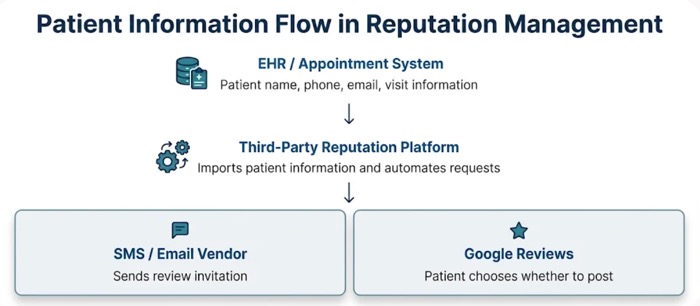
The compliance risk is concentrated at the points where patient information moves between vendors. For example, a reputation company may have its own BAA with the medical practice but rely on another company to store patient contact information or send messages. The practice manager should determine whether those downstream vendors receive PHI and, when required, have appropriate subcontractor BAAs and safeguards. A single vendor BAA does not automatically make every integration compliant.
One important distinction: sending a review invitation is not inherently a HIPAA violation. Its permissibility depends on the purpose, data used, recipients, vendor arrangements, and safeguards. It should not be treated automatically like a HIPAA-permitted appointment reminder. Other requirements, including applicable texting and consumer protection laws, may also apply.
What happens when the practice discovers a PHI breach?
If an ORM service exposes unsecured PHI and the incident qualifies as a reportable breach, the provider may have to:
- Investigate and document what happened.
- Determine which patients and data were affected.
- Notify affected individuals without unreasonable delay and no later than 60 days after discovery.
- Notify HHS according to the applicable reporting requirements.
- Notify media outlets when the breach affects more than 500 residents of a state or jurisdiction.
- Implement corrective measures, including vendor changes and employee training.
Not every incident is a reportable breach, but HIPAA requires a documented assessment when an impermissible use or disclosure occurs. HHS.gov Beyond legal exposure, the practice may incur attorney fees, forensic investigation costs, staff time, remediation expenses, patient complaints, and damage to trust.
What should a practice manager demand from an Online Reputation Management vendor?
Use this checklist when evaluating a service:
[ ] Will the vendor sign a BAA covering its reputation management services and the PHI it handles?
[ ] Are all subcontractors that handle PHI covered by required downstream BAAs?
[ ] Are review invitations designed to avoid unnecessary patient and treatment information?
[ ] Does the platform provide appropriate encryption, access controls, and audit logs?
[ ] Are staff and automated public review responses designed not to disclose PHI?
[ ] Does the service have clear patient testimonial authorization procedures?
[ ] Can the vendor explain its incident detection, reporting, and breach response process?
[ ] Does the vendor document data retention, deletion, and access removal procedures?
How does PatientGain’s ReputeMD work and address HIPAA?
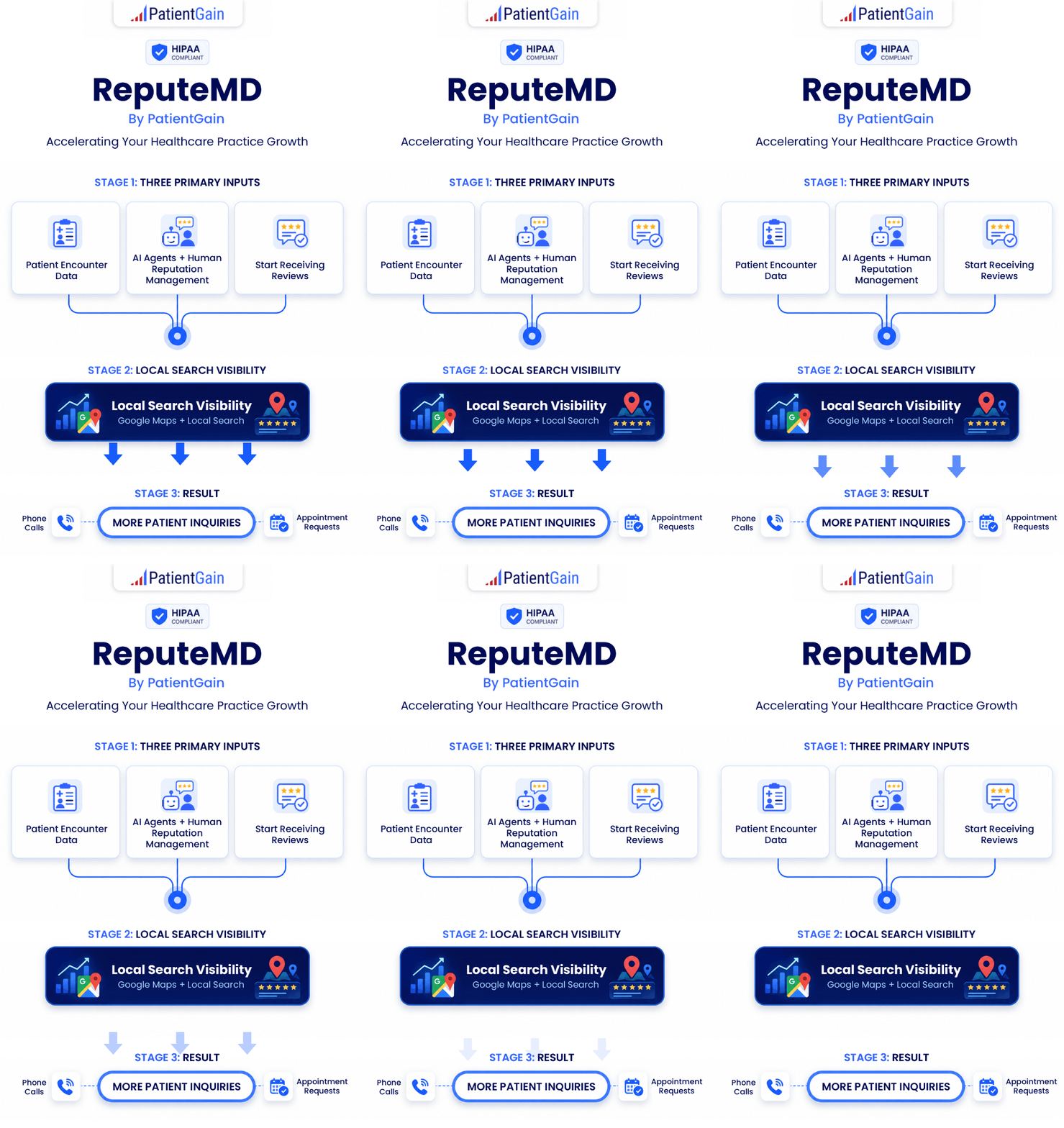
Your medical practice should not have to choose between building a stronger online reputation and protecting patient privacy. An effective healthcare reputation management service should make both priorities part of the same workflow. PatientGain’s ReputeMD is an automated online reputation management tool designed specifically for healthcare practices. It focuses on increasing the volume of online reviews on platforms like Google and Yelp while strictly adhering to HIPAA privacy standards. ReputeMD is PatientGain’s healthcare-focused, Done-For-You (DFY) Online Reputation Management service. It helps medical practices automatically request patient reviews, monitor their online reputation, collect feedback, and reduce the manual work involved in reputation management.
ReputeMD’s central advantage is that it combines
1) EHR integration,
2) Automated patient communications (with AI Agent under HITL)
3) Kiosk mode
4) In lobby texting mode
5) Direct personal Email mode (also called Provider mode)
6) Website mode
7) Business Associate Agreement (BAA),
8) Data security controls, and
9) Human oversight in one managed service
10) Done-For-You service.
ReputeMD capabilities, including an included BAA and HIPAA-focused workflows.
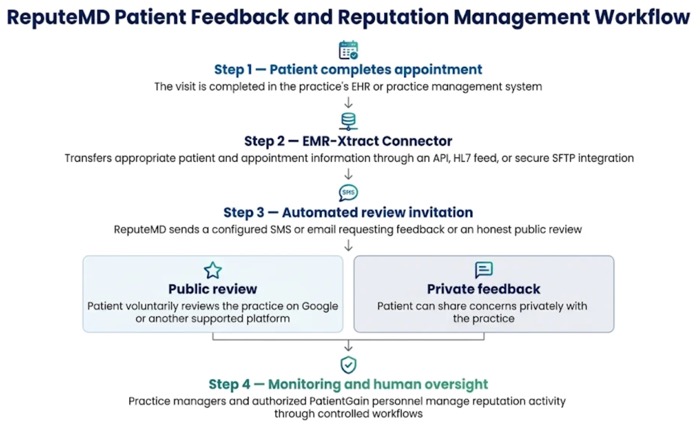
For a practice manager, the principal benefit is that front-desk employees do not have to manually export patient lists, remember to send review invitations, or monitor every review site individually.
Seven ways ReputeMD addresses HIPAA-related risks
PatientGain’s safeguards and the specific risks they are intended to reduce.
| HIPAA risk | ReputeMD’s stated safeguard | Why it matters to a practice manager |
|---|---|---|
| Patient data transferred to an unauthorized vendor | PatientGain includes a BAA with ReputeMD | Establishes contractual responsibilities for permitted PHI handling |
| Insecure EHR data transfer | EMR-Xtract supports secure APIs, HL7 integrations, and SFTP | Helps protect information transferred from the practice |
| Excessive clinical data collection | ReputeMD describes using limited appointment and contact fields | Reduces unnecessary exposure of diagnoses and medical records |
| Unauthorized access to patient feedback | Encrypted storage, role-based access, and audit logging are described | Helps restrict and monitor access to information |
| PHI inadvertently disclosed in review responses | AI assistance with human review before public responses are posted | Adds a check against public disclosure of sensitive information |
| Patient testimonials published without permission | PatientReel offers digital HIPAA marketing authorization tracking | Helps document permission before publishing patient videos |
| Practice staff using unsafe manual tools | Automated, centralized, Done-For-You workflows | Reduces reliance on spreadsheets, personal phones, and ad hoc processes |
Why Does PatientGain’s ReputeMD Prefer HL7 or SFTP for EMR Integration?
ReputeMD uses HL7 and Secure SFTP integrations with EMR systems primarily to balance universal software compatibility with strict HIPAA data security. The main reasons are lower integration costs, compatibility with existing EMRs, stronger control over data sharing, and simpler automation.
PatientGain’s ReputeMD does not need access to a patient’s complete medical record. Its primary integration requirement is much simpler: identify when a patient completes an appointment and obtain the appropriate contact information to send a review invitation. ReputeMD’s interactions are typically one-way extraction from the EMR to ReputeMD.
PatientGain’s EMR-Xtract Connector supports three methods: HL7 feeds, secure SFTP transfers, and direct APIs. PatientGain states that many EMRs prefer scheduled SFTP exports or HL7 feeds because they offer operational separation and can be easier to implement.
Comparing the three methods
| Feature | HL7 feed | SFTP transfer | Direct API |
|---|---|---|---|
| How it works | EMR sends event messages | EMR exports files on a schedule | Application exchanges data through API endpoints |
| Best for | Existing event-driven EMR interfaces | Routine appointment data exports | Modern cloud-based EMRs |
| Data timing | Often near real-time | Typically hourly or daily | Real-time or scheduled, depending on API |
| Complexity | Moderate if interface exists | Often relatively low | Depends on vendor |
| EMR vendor fees | Possible | Possible | Possible |
| Data access | Selected event/message fields | Selected exported fields | Depends on API permissions |
| ReputeMD suitability | Excellent | Excellent | Excellent |
One technical distinction: HL7 is a family of healthcare data-exchange standards; SFTP is a secure file-transfer protocol. They are not mutually exclusive. An HL7-formatted file can also be transmitted using SFTP.
Why SFTP is particularly attractive for ReputeMD
Consider a medical practice completing 150 appointments daily. Rather than maintaining a continuous connection to its EMR, the practice can configure a daily export.
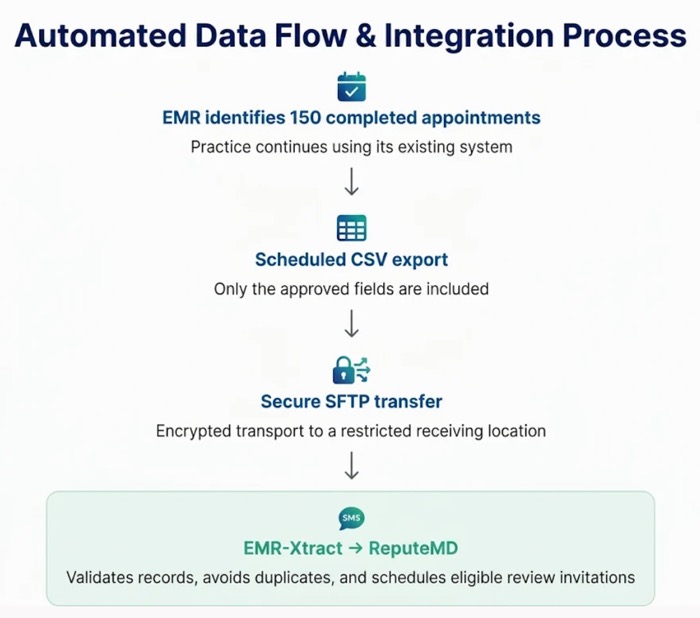
This has several practical advantages:
- No need to give ReputeMD broad, continuous access to the EMR.
- The practice controls which records and fields are exported.
- EMR vendors may already offer scheduled exports.
- A batch can support hundreds or thousands of appointments across multiple locations.
- Operational failures can be detected and corrected through file reconciliation and retry procedures.
A scheduled export also means review requests may be delayed until the next successful transfer. PatientGain’s confirms that SFTP with HL7 is one of its supported integration methods.
Why not use APIs for everything?
APIs can be excellent, but they are not always the least expensive or simplest approach for this particular use case. A modern EMR might expose an API for retrieving patient information while offering no convenient API event indicating that an appointment was actually completed. Additional polling, mapping, authentication, or vendor customization might be required.
The U.S. Office of the National Coordinator for Health IT has found that much hospital data exchange with third-party applications still uses proprietary APIs or non-API methods such as HL7 interfaces, despite the growth of standards-based APIs.
For ReputeMD, that creates a practical decision:
- Use HL7 when the EMR already provides reliable appointment or checkout event messages.
- Use SFTP when the EMR can generate reliable scheduled exports and real-time triggering is unnecessary.
- Use an API when the EMR has a suitable, supported, reasonably priced interface for appointment status and patient contact information.
Why these methods can support HIPAA compliance
The most useful compliance advantage is limited, controlled data exchange, not that HL7 or SFTP automatically makes an integration HIPAA compliant. With an appropriately configured interface, PatientGain receives the information necessary for the agreed workflow without broadly accessing clinical records.
However, several safeguards remain necessary:
- HL7 interfaces need appropriate transmission security; HL7 messaging alone does not provide encryption.
- SFTP protects data in transit, but received files also require secure storage, access controls, retention policies, and deletion procedures.
- Both methods require appropriate logging, authentication, and incident-response processes.
- PatientGain’s BAA covers the applicable PHI handling, with required agreements for relevant subcontractors (AWS).
The economic reason is especially important
PatientGain’s EMR-Xtract is included with ReputeMD at no additional PatientGain connector charge, although EMR vendors may separately charge (sometimes) for enabling HL7 interfaces, APIs, or SFTP exports. Using an existing EMR export can therefore avoid building and maintaining a custom integration for a relatively simple administrative workflow.
 Send Text
 How may I help you?