

What is Patient Conversion Attribution in Healthcare Marketing?
Patient Conversion Attribution in healthcare marketing is the analytical process of tracking and assigning value to the specific marketing touch points a prospective patient interacts with before taking a desired action, such as booking an appointment, filling out an intake form, or calling an admissions line. It is the process of identifying which marketing channels, campaigns, advertisements, website interactions, and patient touch points contributed to a person becoming a new patient at a healthcare practice.
Because the healthcare decision-making process is rarely a straightforward, impulse-driven choice, patients often engage with multiple channels—like reading a blog post, clicking a Google Ad weeks later, and finally calling the clinic directly—before committing to care. Conversion attribution reveals which of these efforts actually generated the patient, rather than just tracking surface-level metrics like clicks or page views.

Why Attribution Matters in Healthcare
Relying on generic reporting often leads healthcare marketers to overfund campaigns that generate cheap, unqualified leads while underfunding the channels that quietly drive actual admissions. Proper attribution solves this by providing:
- Accurate Return on Investment (ROI): It connects marketing spend directly to business outcomes (booked appointments or intake completions), ensuring budgets are allocated to channels that yield real revenue.
- Lower Customer Acquisition Cost (CAC): By identifying exactly which touchpoints efficiently convert patients, clinics can optimize their campaigns and lower the overall cost of acquiring a new patient.
- Patient Journey Mapping: It exposes patterns in how patients research symptoms, evaluate providers, and make decisions over long conversion windows.
Common Attribution Models
Healthcare organizations utilize different models to weigh the importance of various touchpoints in a patient’s journey:
- First-Touch: Gives 100% of the credit to the very first interaction (e.g., an organic search for “knee pain causes”). Best for measuring brand awareness and initial discovery.
- Last-Touch: Gives 100% of the credit to the final interaction before the conversion (e.g., a branded Google Ad search for “Smith Orthopedics”). This is the default for many analytics tools but often ignores the research phase.
- Linear: Distributes credit equally across every touchpoint the patient interacted with.
- Multi-Touch (Data-Driven / Position-Based): Assigns fractional, weighted credit to each touchpoint based on its actual statistical influence on the patient’s decision. This is the most accurate but requires clean data and advanced tracking infrastructure.
- Incrementality (Causal Marketing): Uses holdout groups and geographic testing to measure which marketing efforts actually caused the conversion, proving that the patient wouldn’t have booked an appointment without seeing the ad.
Unique Challenges in Healthcare Attribution
Healthcare marketers face hurdles that standard e-commerce businesses do not:
- HIPAA and Privacy Compliance: Strict data privacy regulations limit standard tracking methods. Marketers must track conversions without exposing Protected Health Information (PHI) to third-party ad platforms like Google or Meta.
- Offline Conversions: Many high-value healthcare conversions happen over the phone or in person. Connecting an offline admission back to the specific digital campaign that generated it requires robust call tracking and CRM integrations.
- Long Decision Cycles: Behavioral health, specialized surgeries, and long-term care often involve weeks or months of research and multiple decision-makers (like family members), making it easy to lose the tracking thread between the first click and the final admission.
How does PatientGain’s EMR-Xtract app helps bridging the gap in patient attribution?
PatientGain’s EMR-Xtract Connector helps bridge one of the biggest gaps in healthcare marketing: connecting a prospective patient’s marketing inquiry to what actually happened in the practice’s Electronic Medical Record (EMR) or Practice Management (PM) system. Most healthcare marketing platforms can measure website visitors, phone calls, appointment requests, and online leads. But these events do not necessarily mean that a new patient attended an appointment.
PatientGain’s EMR-Xtract addresses the clinical-data side of that problem by securely connecting appointment and patient records with PatientGain’s patient engagement applications.
PatientGain’s EMR-Xtract supports HL7 feeds, APIs, and secure SFTP transfers to synchronize patient information and appointment-related events. Since it uses standards based interface, most common HL7 feeds, it can communicate and with more than 100 EMRs and PMs available today. There are very few EMRs and PMs that do not support HL7 feeds. These systems are either too small or too new in the healthcare business.
However, note just because an EMR supports HL7 feeds does not mean configuring the connection is instant. Many legacy EMR vendors charge steep, individual “interface fees” or require HL7 or CSV files to be placed on a SFTP servers. It also depends on your contract with an EMR company. Many practice managers have negotiated that the EMRs will provide a nightly drop of patient appointments with no to little fees “interface fees” or require HL7 or CSV files to be placed on a SFTP servers. PatientGain’s official documentation more realistically notes that they have designed integrations to support over 100 major EMR/EHR systems. For example one of PatientGain’s customer has 14 locations, and this medical group agreed to pay $120/mon/location to a major EMR provider. However, during the renewal process it was waived.
The important distinction is that EMR-Xtract provides the data connection necessary for closed-loop attribution; it does not, by itself means that complete marketing-to-visit attribution. That requires reliable matching between marketing leads and EMR outcomes.
Six Ways EMR-Xtract Can Improve Attribution
| Capability | How it helps the practice |
|---|---|
| 1. EMR appointment synchronization | Provides appointment status data instead of relying exclusively on marketing-form submissions |
| 2. Completed-visit verification | Can distinguish attended appointments from unconverted inquiries when the EMR supplies reliable visit-completion data |
| 3. New versus existing patient identification | Can improve classification of acquired patients, if registration history and matching are supported |
| 4. Automated data transfers | Reduces manual CSV exports and repeated front-desk data entry |
| 5. Multi-location synchronization | Can associate patient outcomes with the correct clinic location |
| 6. Attribution reporting integration | Can provide outcome data needed to calculate cost per acquired patient when connected to marketing-source records |
These are potential attribution benefits of a properly configured integration. PatientGain specifically documents appointment-data synchronization, data cleaning, deduplication, and automated patient engagement.
Example: A Four-Location Medical Practice
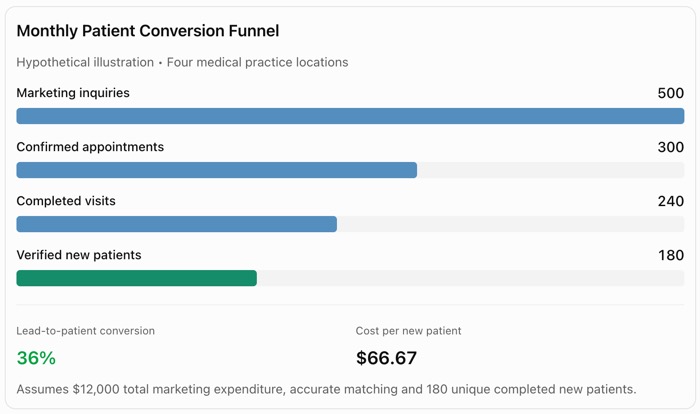
Suppose your medical group operates four locations and receives 500 monthly inquiries from Google Ads, SEO, Google Business Profile, and social media. Without integration, the marketing dashboard may report 500 leads, but the practice manager cannot confidently determine how many turned into completed new-patient visits. With EMR-Xtract providing completed-visit information, an appropriately configured attribution system could produce data like below.
How EMR-Xtract Connects With Other PatientGain Apps
PatientGain‘s EMR-Xtract as an integration utility used alongside its patient engagement and reputation management products. Its broader PLATINUM service also advertises lead funnels, a patient CRM, HIPAA-focused analytics, and the Single Point of Conversion app.
| PatientGain component | Role in patient attribution |
|---|---|
| HIPAA-focused analytics | Identifies marketing channels and campaign interactions |
| Single Point of Conversion (SPOC) | Centralizes prospective-patient communications and inquiries |
| Lead Funnel / CRM | Maintains lead records and follow-up status |
| EMR-Xtract | Supplies permitted EMR/PM patient and appointment information |
| Attribution reporting | Connects lead records with completed visits if matching and reporting are supported |
| ReputeMD | Uses completed-visit events to automate post-visit review invitations |
An important published example is ReputeMD. PatientGain documents how EMR-Xtract can detect appointment completions and trigger review invitations without requiring staff to manually export patient data. This is evidence of an operational connection between EMR events and patient engagement workflows.


 Send Text
 How may I help you?