

Physician Persona Optimization For Healthcare Local SEO
Common question asked by Practice Managers: Does Physician Persona Optimization helps with healthcare local SEO?
Yes, Physician Persona Optimization directly and significantly improves healthcare local SEO. When you optimize individual provider profiles, you help practice locations rank higher in local search results and attract patients who are looking for specific specialists.
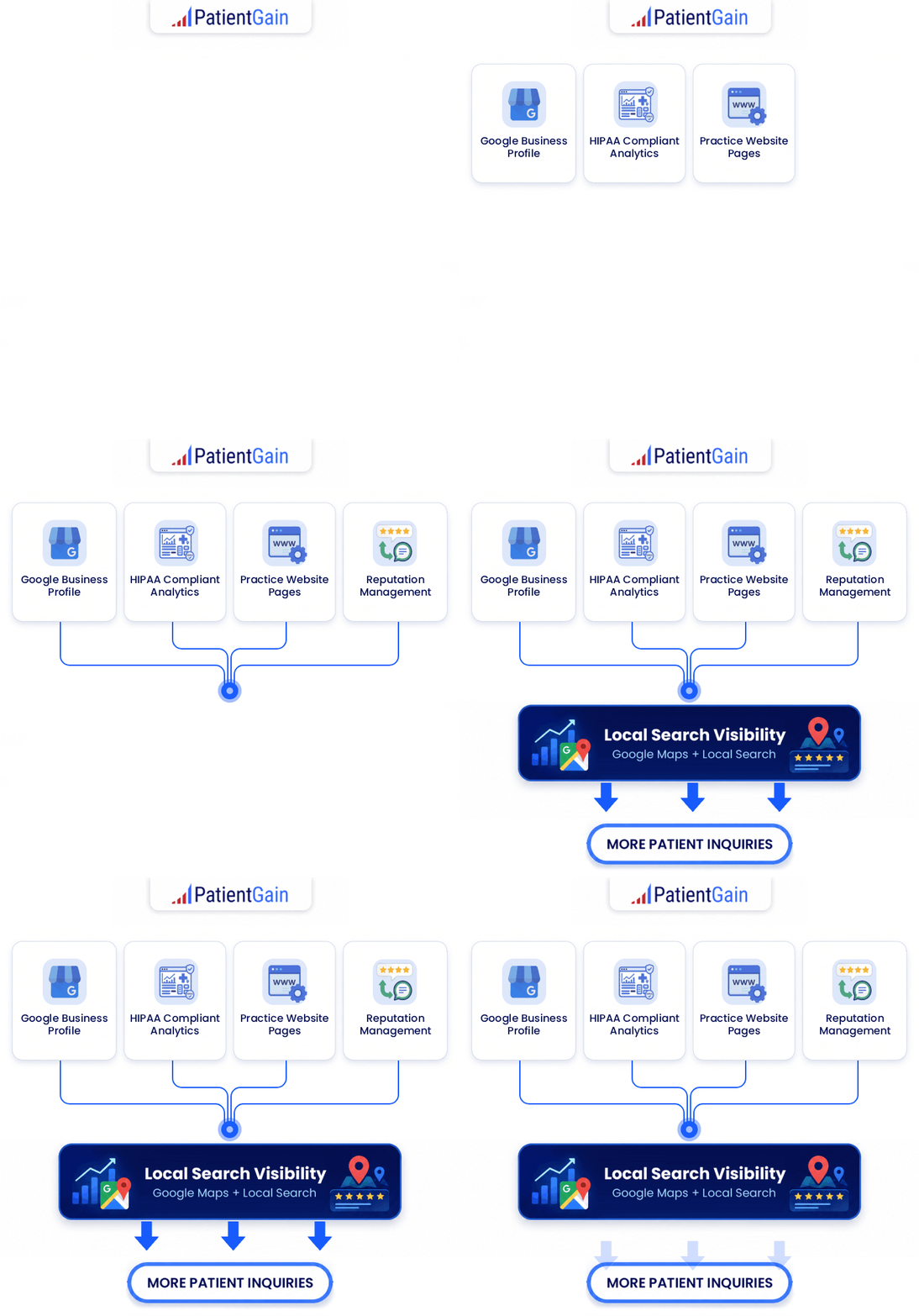
Medical practices often make the mistake of only optimizing their main brand or facility page. However, patients frequently search for specific treatments, conditions, or individual doctor names rather than the practice brand itself.
How Physician Persona Optimization Boosts Local Rankings
- Captures “Near Me” and Specialist Queries: Patients searching for “cardiologist near me” or “best knee replacement surgeon in [City]” are served Google Business Profiles (GBPs) of individual practitioners alongside practice locations. Optimizing a physician’s persona ensures their individual GBP ranks for these high-intent queries.
- Maximizes Google Business Profile (GBP) Real Estate: Google explicitly allows medical practices to create individual GBPs for each public-facing physician. By optimizing these individual profiles in tandem with the practice profile, your clinic can occupy multiple spots in the coveted Local 3-Pack.
- Strengthens E-E-A-T Signals: Google’s search algorithms heavily weigh Experience, Expertise, Authoritativeness, and Trustworthiness (E-E-A-T) for healthcare content (classified as “Your Money or Your Life” or YMYL). Linking optimized physician bios, their NPI numbers, medical licenses, and published articles to your website signals high authority to search engines, boosting the overall domain’s local authority.
- Drives Long-Tail Keyword Traffic: While your practice site might target broad terms like “pediatric clinic,” individual doctor optimization allows you to target highly specific long-tail keywords based on a provider’s sub-specialties (e.g., “pediatric asthma specialist” or “infant food allergy doctor”).
Key Implementation Steps for Practice Managers
| Optimization Pillar | Tactical Action Item |
|---|---|
| Google Business Profiles | Create separate GBPs for each practitioner. Ensure the primary category reflects their exact specialty (e.g., Dermatologist) rather than the generic practice category (Medical Clinic). |
| NAP Consistency | Standardize Name, Address, and Phone number across all profiles. Ensure the individual doctor’s profile lists their direct line or department number rather than the main clinic line to avoid internal keyword/profile cannibalization. |
| Dedicated Bio Pages | Build an individual, schema-marked landing page on your practice website for each doctor. Include their bio, accepted insurances, clinical interests, education, and patient reviews. |
| Review Strategy | Train front-desk staff or set up automated SMS/email flows to ask patients for reviews that mention the doctor’s name and the specific treatment received. This contextual relevance heavily influences local search algorithms. Or you can use ReputeMD service from PatientGain. |
8 important components of Physician Persona Optimization
| Optimization activity | Potential local SEO benefit |
|---|---|
| 1. Dedicated physician biography pages | Helps Google understand the doctor’s specialty, credentials, and practice affiliation |
| 2. Physician Google Business Profiles | Can improve visibility in Google Maps and physician-name searches when eligible |
| 3. Consistent physician directory listings | Reduces conflicting information across medical directories |
| 4. Physician-specific reputation management | Builds patient confidence and may contribute to online prominence |
| 5. Specialty and treatment-focused content | Supports relevance for specific healthcare searches |
| 6. Structured data (Physician schema) | Helps search engines interpret physician information; no guaranteed ranking improvement |
| 7. Credentials and clinical expertise | Demonstrates qualifications and supports patient trust |
| 8. Accurate location associations | Connects providers with the clinics where they actually see patients |
Conclusion:
Physician Persona Optimization is a cornerstone of modern healthcare local SEO because Google treats individual practitioners and the clinics they work in as distinct, independent entities. For Practice Managers, optimizing individual physician profiles alongside the main practice brand creates a multiplier effect on local search visibility, directly driving higher patient acquisition.
How does PatientGain’s ReputeMD service works for Physician Persona Optimization?
PatientGain’s ReputeMD is an automated, HIPAA-compliant reputation management service specifically designed to build and optimize the online presence of individual doctors—a core component of Physician Persona Optimization.
Instead of relying on front-desk staff to manually ask for reviews, ReputeMD integrates directly with the clinic’s software (called EMR – by using EMR-Xtract app) to automatically drive patient feedback to a physician’s individual Google Business Profile (GBP) and other healthcare directories (like Healthgrades and WebMD).
1. Automated “Touchless” Review Generation
The core engine of ReputeMD is its integration with your existing practice software.
- EMR Integration: Using PatientGain’s “EMR-Xtract” connector, ReputeMD integrates with over 100 EMR/EHR systems (like athenahealth, eClinicalWorks, or AdvancedMD) via secure APIs, HL7 data feeds, or encrypted file transfers.
- The Trigger: The moment a patient finishes their appointment and is marked as “Checked Out” in the EMR, the system securely extracts basic contact details (name, phone, email, appointment date, and the specific provider seen).
- The Outreach: It automatically sends a customized SMS text or email to the patient, asking them to review the specific physician they just saw.
2. SEO Impact: Feeding the Algorithm
By constantly driving reviews to an individual doctor’s profile, ReputeMD feeds search algorithms the specific ranking signals they favor:
- Velocity and Recency: A steady, continuous stream of new reviews signals to Google that the physician is actively practicing and currently delivering high-quality care, which boosts their local search ranking.
- Keyword Generation: Because the app prompts patients to describe their experience, patients naturally use long-tail keywords (e.g., specific symptoms, conditions, or treatments like “knee replacement” or “gentle pediatric dentist”). Google parses this user-generated content to match the physician’s profile with specialized, high-intent local searches.
3. FTC and Google Compliant Feedback Loop
“Review gating”—the practice of filtering out unhappy patients and only asking happy ones to leave a public review—is strictly prohibited by Google and the FTC. ReputeMD handles this compliantly:
- Equal Opportunity: Every patient receives the exact same invitation to leave a public review on Google, Healthgrades, or Yelp.
- Internal Feedback Mechanism: Patients are also given the option to answer a brief internal survey. If a patient submits a negative score internally, it generates a real-time alert to the Practice Manager. This allows the practice to immediately contact the patient to resolve the issue, which often naturally prevents a negative public review.
- The Math: Because ReputeMD asks every patient, the sheer volume of happy patients naturally drowns out the occasional negative review. PatientGain notes that statistically, over 95% of patients leave 4- or 5-star reviews when asked. However you should expect that some patients are unhappy. This is normal. If a practice or any business claims to have 5.0 rankings, and they have more than 100 reviews, they are “gating the reviews”. This is PatientGain’s view and it is also supported by Google’s data. See example below:
- The “Gating” Claim: PatientGain explicitly points out that maintaining a perfect 5.0 rating across a high volume of reviews (like 100+) is statistically improbable in real-world consumer/patient experiences. They argue that achieving this usually requires review gating (intercepting unhappy customers internally and only sending happy ones to public sites) or artificial manipulation.
- The Data/Consumer Trust Factor: PatientGain’s published insights note that consumers and patients actually view a flawless 5.0 rating with skepticism, suspecting that reviews have been filtered or faked. According to their data, the “sweet spot” for high consumer trust usually sits between 4.5 and 4.9, because a stray minor critique or human error signals an authentic, un-manipulated feedback profile.
- Summary: While some aggressive marketing agencies utilize gating to artificially force a 5.0 score, PatientGain explicitly warns against it—both because platforms like Google penalize review gating and because data shows consumers trust a realistic, high rating (like 4.8 with 100+ reviews) far more than a “too good to be true” 5.0.
- PatientGain does not promote “review gating” or implements “review gating”.
4. Video Testimonials (PatientReel) This is optional feature of ReputeMD
Once a patient leaves a positive 4 or 5-star text review, ReputeMD can prompt them to record a short video testimonial using an integrated app called PatientReel. These videos are highly effective when embedded directly onto the physician’s dedicated biography page on the practice website, massively increasing patient trust and conversion rates.
 Send Text
 How may I help you?