

What is a BAA for a healthcare website?
A Business Associate Agreement (BAA) for a healthcare website is a legally binding contract required by HIPAA that ensures third-party vendors protect patients’ Protected Health Information (PHI). If your website collects, stores, or transmits health data (such as booking forms, patient portals, or contact forms asking about medical conditions), any vendor with backend access to that data is considered a Business Associate and must sign a BAA.
When a Healthcare Website Needs a BAA
You must establish a BAA with any vendor whose software or services handle PHI through your website. Common examples include:
- Web Hosting Providers: Companies storing your website’s database and server files (e.g., AWS, Google Cloud, or specialized HIPAA-compliant hosts).
- Form Builders & Plugins: Third-party tools used to collect patient intake forms, appointment requests, or symptoms.
- Email & SMS Marketing Services: Platforms used to send appointment reminders, treatment plans, or health updates.
- Analytics Providers: Tracking tools (like Google Analytics) if they capture identifiable user behavior linked to health searches or patient IDs.
- CRM & Patient Portals: Customer relationship management software used to track patient interactions.
Core Components of a BAA
A standard BAA outlines exactly how the vendor will safeguard PHI and includes several strict requirements:
- Permitted Uses: Defines exactly what the vendor can and cannot do with the health data.
- Safeguards: Requires the vendor to implement administrative, physical, and technical protections (like data encryption).
- Breach Notification: Binds the vendor to immediately report any data breaches or unauthorized PHI disclosures to the healthcare provider.
- Subcontractor Compliance: Ensures that any subcontractors the vendor uses are also bound by the same HIPAA protections.
- Data Destruction: Mandates how PHI will be returned or securely destroyed once the contract ends.
What Happens Without a BAA?
Using a standard consumer-grade service (like a basic contact form or cheap shared hosting) to handle patient data without a signed BAA is a direct violation of HIPAA regulations. Even if the software is technically secure, the lack of a legal agreement exposes the healthcare provider to severe financial penalties and legal liability from federal regulators.
Example Use Case – Single location primary care with some walk-in-medicals services (Like urgent care)
Question – We have small single location medical practice – primary care and urgent care service. The website was built by a freelancer on free wordpress. There are contact forms that send us an Email for new leads. We run my own PPC Max ads on Google, and some times run promotions on Meta. We also track website stats on Google analytics. We use mailchimp email marketing, and an SEO person from India (Manages website, SEO, plugins, forms), what is the issue with this setup?
This setup contains multiple critical HIPAA and Business Associate Agreement (BAA) violations across your web host, lead collection, marketing tools, and vendor access. Transmitting or storing prospective patient data across these unencrypted services exposes your practice to severe regulatory liability and enforcement penalties. The issue is not that you are a small practice or that you built things inexpensively; the problem is that patient/lead information may pass through several vendors that either do not offer a BAA, should not receive PHI, or have not been configured for healthcare use.
A BAA also does not magically make an entire marketing stack HIPAA compliant. You have to look at the actual data flow: Patient → website → form → hosting/plugin → email → analytics/ad trackers → marketing platform → outside contractors. HHS says that when an outside service creates, receives, maintains, or transmits PHI on behalf of a covered entity, a business-associate relationship and appropriate BAA are generally required.
| Your setup | Risk | Main issue |
|---|---|---|
| Free WordPress website | 🔴 High/depends | Hosting (GoDaddy), plugins, backups and forms may touch PHI without BAAs |
| Website contact forms → email | 🔴 High | Patient inquiries can contain PHI and may pass through several vendors |
| Google Analytics | 🔴 High | Google does not offer a BAA for Google Analytics |
| Google Performance Max | 🟠 Medium–High | Ads are possible, but conversion/remarketing/customer data can create PHI disclosure issues |
| Meta promotions | 🔴 High if Pixel/CAPI used | Health-related visitor/event information should not be sent to Meta |
| Mailchimp | 🔴 High for patient lists | Patient/lead lists can themselves reveal a healthcare relationship |
| Freelancer | 🟠 Depends | BAA/access controls needed if the freelancer can access PHI – Every person who works for you as a vendor (And potentially has access to PHI) must have a BAA signed with your practice. |
| SEO person overseas | 🟠 Depends | Location isn’t the core problem; access to PHI, forms, analytics, accounts or databases is. If there is a breach, enforcing BAA on a foreign national or company is very risky. If they have access to the site, analytics, email accounts, or admin panels, they may be handling PHI. You need role based access and a formal BAA contract if they can see PHI. An you should have a audit-trail. |
1. Contact Forms and Unsecure Email
- The Issue: When prospective patients submit lead forms (name, phone number, care needs, or appointment requests), that data becomes electronic Protected Health Information (ePHI).
- The Violation: Standard contact forms on free WordPress sites typically store form entries in plain text on the database and send notifications via standard, unencrypted email (SMTP), violating the HIPAA Security Rule.
2. Google Analytics and Meta Ad Pixels
- The Issue: Meta Pixels and Google Analytics (GA4) run scripts that track visitor IP addresses, device IDs, and page paths (e.g., landing on an urgent care or primary care request page).
- The Violation: Department of Health and Human Services (HHS) guidance explicitly prohibits transmitting user-identifiable data from healthcare sites to third parties without a signed BAA. Neither Google (for GA4) nor Meta will sign a BAA for their tracking tools.
3. Mailchimp Marketing
- The Issue: Importing lead contact lists or patient emails into Mailchimp for promotional campaigns.
- The Violation: Mailchimp’s terms strictly prohibit handling PHI, and the company does not sign BAAs. Associating an individual’s name/email with a specific medical practice’s promotional list constitutes ePHI.
4. Freelancer and Offshore SEO Access
- The Issue: Granting backend website or database access to external contractors (your freelance developer and SEO specialist in India).
- The Violation: Any contractor who has access to systems containing or processing ePHI qualifies as a Business Associate under HIPAA. You are legally required to have a signed BAA with them before granting access. Furthermore, enforcing U.S. BAA contracts with offshore individuals in non-US jurisdictions adds significant compliance risk.
5. WordPress Hosting
- The Issue: Hosting a medical site on WordPress infrastructure like GoDaddy is not secure.
- The Violation: WordPress infrastructure like GoDaddy hosting platforms do not offer BAAs, lack mandated administrative audit logs, and fail to provide HIPAA-grade server security safeguards.
If I use PatientGain VaultDocSite, can I address these HIPAA and BAA issues?
Switching to PatientGain VaultDocSite directly addresses your practice’s HIPAA and BAA vulnerabilities by replacing your unsecure WordPress stack with a specialized medical platform. PatientGain provides a signed Business Associate Agreement (BAA) covering site hosting, form collection, and integrated practice marketing tools.
How VaultDocSite Resolves Each Setup Issue
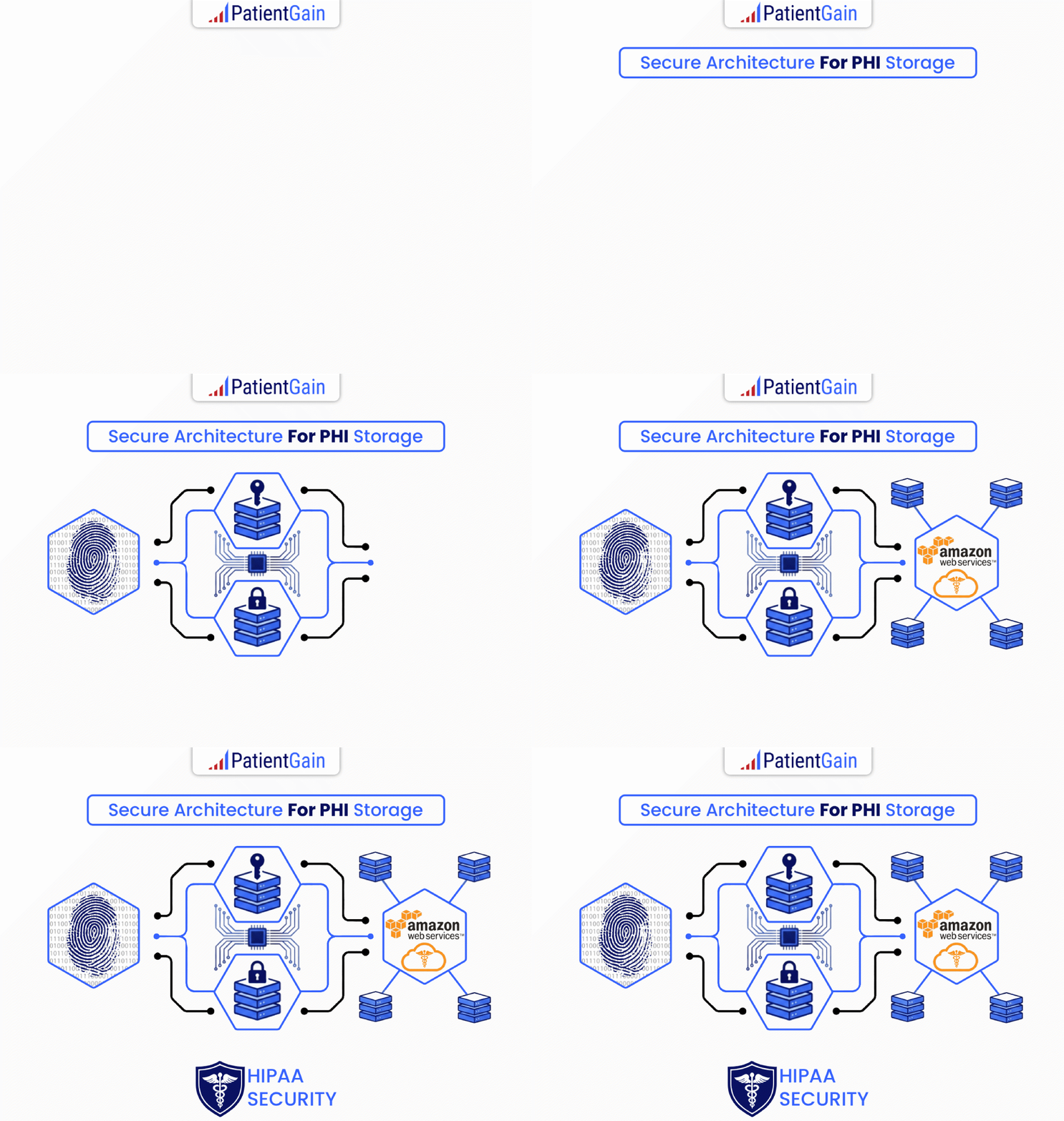
- Web Hosting & Forms: Replaces free WordPress hosting with BAA-backed cloud servers on AWS/Google Cloud. Patient lead forms bypass standard MySQL databases and transmit directly into an isolated, encrypted vault accessible via a secure dashboard.
- Ad Tracking & Analytics: Provides native, HIPAA-compliant tracking guardrails that anonymize user IP addresses and page interactions before transmitting data to ad networks, preventing HHS tracking pixel violations.
- Email Marketing: Replaces non-compliant platforms like Mailchimp with PatientGain’s integrated marketing and patient communication tools, all covered under their overall BAA.
- Freelancer & SEO Access: Eliminates the compliance hazard of granting external contractors open backend database access. PatientGain manages SEO and site maintenance internally under strict role-based access controls.
Important Steps for Compliance
- Execute the BAA: Ensure you explicitly request, receive, and sign PatientGain’s BAA before launching the new site.
- Audit Active Ad Campaigns: Confirm that your Google PPC and Meta Ad campaigns do not contain custom, unmasked tracking tags hardcoded onto appointment landing pages.
- Clean Up Legacy Systems: Once migrated, delete old form submission logs stored in your previous WordPress database and unencrypted email accounts, and revoke contractor access to your domain registrar.

 Send Text
 How may I help you?