

HIPAA Compliant Marketing For Doctors Offices
HIPAA-compliant marketing for a doctor’s office is the practice of promoting medical services, acquiring new patients, and running digital ad campaigns without exposing electronic Protected Health Information (ePHI) or sharing identifying visitor data with third-party advertising vendors without a Business Associate Agreement (BAA).
Core Regulatory Definition Under HHS Office for Civil Rights (OCR) rules, “marketing” is defined as any communication that encourages a recipient to purchase or use a health-related product or service. If a campaign relies on identifiable patient data—ranging from email lists and medical histories down to IP addresses and URLs logged on condition-specific pages—it requires signed, written patient authorization unless executed through a BAA-covered, privacy-safe pipeline.
From the perspective of a Practice Manager and Practice Owner, what does it mean ?
It does not mean doctors cannot use Google Ads, SEO, websites, email, texting, social media, or marketing analytics. The key issue is what patient information is collected, where it goes, who can access it, and whether the use/disclosure is permitted. HHS specifically regulates uses and disclosures of PHI for marketing and generally requires patient authorization when PHI is used or disclosed for activities that meet HIPAA’s definition of marketing, subject to important exceptions.
What are Permitted vs. Restricted Marketing Activities?
| Marketing Channel | HIPAA Status | Compliance Requirement |
| General Educational Content & SEO | Permitted | Public blog posts and local SEO without tracking cookies or patient data capture. |
| Direct Patient Email & SMS Broadcasts | Permitted | Requires explicit opt-in consent and delivery through BAA-backed encrypted platforms. |
| Patient Reviews & Video Testimonials | Restricted | Requires a signed, written HIPAA authorization form prior to publishing a patient’s story. |
| Unmasked Ad Pixels (Meta/GA4) | Prohibited | Standard tracking pixels streaming raw IP addresses or booking data directly to ad networks violate HIPAA. |
| Selling Patient Lists for Remuneration | Prohibited | Strictly illegal without explicit, signed patient authorization. |
What are Essential Technical Pillars for Digital Compliance?
- Universal Business Associate Agreements (BAAs): Every vendor in your marketing supply chain—including website hosts, CRM platforms, email marketing software, call tracking services, and external ad agencies—must sign a legally binding BAA.
- Server-Side Data Scrubbing: Standard web tags log IP addresses and URLs (e.g.,
[clinic.com/treatment/cardiology](https://clinic.com/treatment/cardiology)). HHS classifies pairing a user’s IP with health context as ePHI. Compliant practices use server-side proxies to strip IP addresses and medical query parameters before data reaches ad platforms like Google Ads or Meta. - Strict Review Response Boundaries: When responding to public reviews on Google or Yelp, staff must never confirm the reviewer is a patient or reference medical details, even if the reviewer disclosed their treatment history in the comment.
- Encrypted Patient Intake: Web contact forms, online scheduling widgets, and 2-way texting tools must utilize TLS encryption in transit and AES-256 encryption at rest, routing submissions directly into a BAA-covered database.
Is PatientGain’s PLATINUM service HIPAA compliant?
Yes, PatientGain’s PLATINUM service is HIPAA-compliant. PatientGain provides a primary, direct Business Associate Agreement (BAA) that legally covers the entire PLATINUM platform, including its software applications, cloud hosting infrastructure, and human support staff.
PatientGain PLATINUM HIPAA Compliance Architecture
| Compliance Component | PLATINUM Service Implementation | Regulatory Function |
| Legal Coverage Scope | Single, platform-wide Business Associate Agreement (BAA) | Covers website, 20+ native apps, CRM, analytics, and staff workflows |
| Cloud Infrastructure | Encrypted AWS and Google Cloud Platform (GCP) | AES-256 encryption at rest; TLS 1.2+ in transit |
| Analytics Engine | Native SPOSA Server-Side Analytics | Obfuscates IP addresses and redacts health-intent query parameters |
| Access Control Model | Advanced Role-Based Access Control (RBAC) | Restricts dashboard views by staff role; blocks non-US IP logins |
| Lead Ingestion Hub | Single Point of Conversion (SPOC) CRM | Encrypts intake forms, online booking, AI chatbots, and 2-way SMS |
| Administrative Controls | Mandated staff HIPAA training and daily audit logs | Satisfies HHS administrative safeguard standards |
Key Safeguards Included in the PLATINUM Service
- Unified Legal Protection: Unlike custom agency setups that require you to manage multiple separate BAAs (for hosting, form builders, SMS tools, call tracking, and CRMs), PLATINUM consolidates your entire digital stack under a single BAA.
- Server-Side Data Obfuscation: The PLATINUM platform completely isolates visitor data. Pageviews, conversion events, and form entries are processed through server-side proxies, preventing raw Protected Health Information (PHI) or IP addresses from leaking to third-party ad networks (e.g., Google or Meta).
- Strict Role-Based Access Controls (RBAC): To meet the HHS “Minimum Necessary” standard, access permissions are strictly segmented. Non-clinical marketing users see aggregated acquisition data, while staff accounts require unique login credentials, feature automatic session timeouts, and block access attempts originating outside the United States.
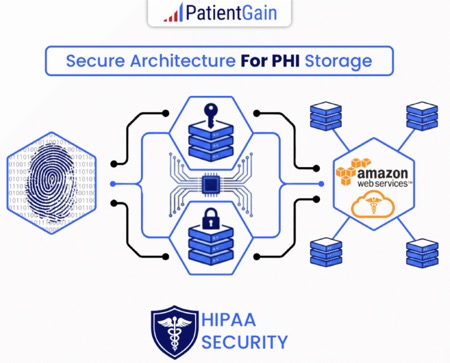
- Database & Hosting Security: PHI collected through contact forms or appointment requests is stored in dedicated, HIPAA-compliant databases on AWS/GCP rather than standard, unencrypted website database tables (such as standard WordPress MySQL tables).
Example Use Case For a 8 Location Practice
If I am healthcare practice with 8 locations (multi-location), how can I use PatientGain’s services with HIPAA compliance and I would like a one BAA rather than 6 BAA’s with multiple companies? What are approx costs with PatientGain’s service?
To operate an 8-location healthcare practice under a single Business Associate Agreement (BAA), PatientGain replaces your fragmented vendor stack with an integrated ecosystem where one US-based BAA legally covers hosting, forms, 2-way texting, CRM, and server-side analytics across all locations.
Approximate Costs for an 8-Location Practice Using PatientGain
| Implementation Path | What’s Included | Monthly Cost (8 Locations) | Upfront Setup Fee |
| SPOSA Standalone Analytics | Server-side GA4 replacement for your current website | $549 – $724/mo ($199 base + $50–$75/add-on site) | $0 (with 12-mo contract) |
| GOLD Multi-Location Suite | High-converting website, essential SEO, CRM, forms, & analytics | $1,399 – $1,699/mo ($899 base + location add-ons) | $0 (with 12-mo contract) |
| PLATINUM Multi-Location Suite | Advanced SEO, AI voice/text agents, 20+ apps, & full analytics | $2,199 – $2,699/mo ($1,699 base + location add-ons) | $0 (with 12-mo contract) |
How PatientGain Replaces 6 BAAs with 1 Comprehensive BAA
Instead of auditing and maintaining six separate software contracts, PatientGain consolidates your digital infrastructure into a single, native application stack covered by one platform-wide BAA:
- Traditional Fragmented Vendor Stack (6 BAAs): Web Host (GoDaddy) + Intake Forms (JotForm) + 2-Way Texting (Podium/Klara) + Call Tracking (CallRail) + CRM (HubSpot) + Analytics Proxy (Freshpaint), Email Marketing (MailCHimp) , SEO COmpany (Usually NO BAA), PPC and Meta Ads company (Usually NO BAA).
- PatientGain Unified Stack (1 BAA): A single legal agreement covering website hosting, secure web forms, 2-way SMS, Single Point of Conversion (SPOC) CRM, AI phone agents, and SPOSA server-side analytics for all 8 locations.
Multi-Location Management Features
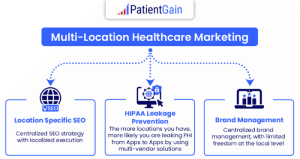
- Centralized Dashboard with Location Filters: Switch instantly between aggregate 8-location group metrics and individual clinic performance (e.g., location-specific ROI, cost-per-lead, and appointment volume).
- Role-Based Access Control (RBAC): Enforce HIPAA’s “Minimum Necessary” standard by granting regional directors full group oversight while restricting local clinic staff to viewing lead logs for their specific address only.
- Isolated Location Attribution: Track organic rankings, Google Ads campaigns, and local map listings separately for each of your 8 physical sites without data cross-contamination.
 Send Text
 How may I help you?