

What is RBAC in HIPAA Compliant Marketing?
Role-Based Access Control (RBAC) in HIPAA-compliant marketing is a technical security control that restricts system access based on an individual’s specific job role. It enforces the HIPAA “Minimum Necessary” standard (45 CFR § 164.502(b)) and Access Control requirement (45 CFR § 164.312(a)(1)), ensuring that internal staff and external marketing teams only see the specific data needed to perform their duties—and nothing more.
PatientGain Privacy Apps Follows HHS Guidance
“The regulated entity can choose to establish a BAA with another vendor, for example a Customer Data Platform vendor, that will enter into a BAA with the regulated entity to de-identify online tracking information that includes PHI and then subsequently disclose only de-identified information to tracking technology vendors that are unwilling to enter into a BAA.”

In a healthcare marketing environment, RBAC prevents media buyers, copywriters, or agency contractors from viewing unredacted Protected Health Information (PHI) while giving intake coordinators the patient details required to schedule appointments.
Typical Role Levels in a HIPAA-Compliant Marketing System
- External Media Buyers & Marketing Agencies (Scrubbed / Aggregated View)
- Access Granted: High-level campaign performance, cost-per-lead, traffic channels, and anonymized conversion totals.
- Access Blocked: Patient names, phone numbers, email addresses, medical condition notes, and unmasked form submissions.
- Front Desk & Intake Coordinators (Lead Action View)
- Access Granted: Inbound lead contact info (Name, Phone, Email, Requested Appointment Time) inside the secure CRM to make follow-up calls and book appointments.
- Access Blocked: Ad campaign budget settings, technical tracking configurations, and administrative platform controls.
- Practice Administrators & Compliance Officers (Full Governance View)
- Access Granted: User management, permission provisioning, security audit logs, data export permissions, and overall platform settings.
- Access Blocked: None (full system control).
- Creative Teams & Copywriters (Asset-Only View)
- Access Granted: Blog drafting tools, social media schedulers, and ad asset libraries.
- Access Blocked: Live patient databases, form entry logs, and CRM contact lists.
Key Technical Capabilities of Marketing RBAC
- Field-Level Data Masking: Automatically obfuscates sensitive fields (e.g., displaying
J*** D***or masking phone numbers(***) ***-5678) for users without high-level clearance. - Immutable Audit Logging: Automatically logs every instance a user views, edits, exports, or deletes a record containing PHI, linking the action to a specific timestamp and User ID for compliance audits.
- Automated Deprovisioning: Allows practice managers to revoke access instantly when an employee leaves or an agency contract terminates, preventing “ghost accounts” from retaining access to patient leads.
- Multi-Factor Authentication (MFA): Requires role-authenticated users to verify their identity via MFA before accessing any marketing dashboard housing lead data.
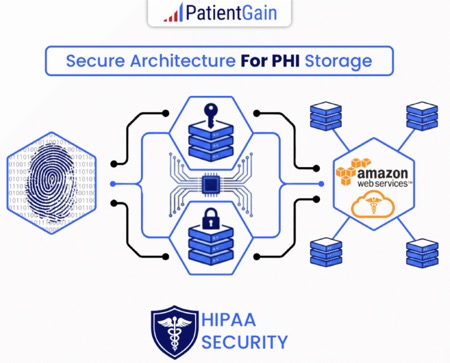
How does PatientGain’s Platinum Service implements RBAC to protect PHI and provide a BAA to healthcare practices?
First, in order to understand how the technical architecture works is based on the concept of “Secure Bubble”. PatientGain implements its “secure bubble” privacy architecture by hosting its entire marketing software and website ecosystem within a unified, HIPAA-compliant Amazon Web Services (AWS) cloud infrastructure. Instead of relying on risky third-party plugins (like WordPress add-ons) or external data-scrubbing middleware, PatientGain places all website hosting, Email marketing, website forms, scheduling apps, AI chatbots, two-way texting, and analytics dashboards inside this single, encrypted bubble covered by a direct Business Associate Agreement (BAA). Essentially anything that can have PHI is in a secure area. Any outside access has to go through a layer of security and checks.
PatientGain’s Platinum Service implements Role-Based Access Control (RBAC) and provides a standard Business Associate Agreement (BAA) to establish a comprehensive framework of administrative, technical, and contractual safeguards. This framework ensures that your performance marketing and patient acquisition efforts comply with federal HIPAA and HITECH standards.
1. How PatientGain Implements RBAC to Protect PHI
The platform enforces strict user access controls to satisfy the HIPAA “Minimum Necessary” standard. This ensures your clinic staff only interact with the data required for their specific job functions.
- Granular User Permissions & Hierarchies: Access is divided into unique, non-shared credentials across defined tiers. Clinic Administrators hold global system access, while Operator-level or front-desk roles are limited strictly to managing incoming tasks, scheduling appointments, or executing localized outreach.
- Walled Off Marketing Analytics: Marketing teams or outside vendors can view performance metrics and campaign ROI without being granted access to the underlying ePHI of individual patient leads.
- Comprehensive Audit Logging: The platform automatically logs every instance of data interaction. If a user views, edits, or exports patient data from the Single Point of Conversion (SPOC) Dashboard, a permanent digital trail is recorded for breach prevention and compliance auditing.
- Geographic Login Restrictions: As part of its access controls, the system blocks platform login attempts originating from outside the United States to neutralize international data threats. The security layer also checks the IP reputation of the users. If user is trying to access from an IP address which has a potential of “bad behavior” it can be blocked.
- Internal Personnel Controls: Behind the scenes, PatientGain enforces internal RBAC. Its own technical and support staff follow strict PHI access guidelines, undergo thorough background checks, receive monthly security and compliance training. Company implements daily security log cross-verification by 2 different humans.
2. How the Platinum Service Handles and Delivers the BAA
The Business Associate Agreement is the foundational contract that legally binds PatientGain to protect your practice’s patient data. However, as a practice owner you also have responsibilities.
- Contractual Execution: Upon signing up for the managed Platinum Service, PatientGain provides its standard BAA. This agreement satisfies the legal mandate requiring a formal contract between a “Covered Entity” (your practice) and a “Business Associate” (the vendor).
- Coverage of the All-In-One Stack: Because the Platinum Service is a consolidated ecosystem, the BAA covers the entire marketing infrastructure. This includes your medical website, custom landing pages, hosting layers, online appointment schedulers, communication apps, and integrated text/SMS systems.
- Secure Infrastructure Backend: The BAA is backed by PatientGain’s deployment on secure, HIPAA-compliant Amazon Web Services (AWS) and Google Cloud Platform (GCP) infrastructure. All ePHI flowing through your Platinum applications is encrypted at rest and in transit (via HTTPS/SSL protocols).
- Compliance Shielding via Data Obfuscation: To uphold the terms of the BAA when interfacing with external networks, the platform includes a “Data Obfuscation” feature. This strips or masks identifying fields from online forms and messages before sending traffic data to secondary tracking environments, ensuring your practice does not inadvertently leak PHI to non-compliant ad networks like Meta, Google or other similar apps, like TikTok.
3. How can PatientGain use AI agents and still address human oversight?
PatientGain’s Platinum Service deploys its proprietary AI marketing agents using a strict Human-in-the-Loop (HITL) architecture. This hybrid model balances generative AI execution speed with strict human oversight. It prevents common AI complications like hallucinations, compliance breaches, or off-brand messaging.
The platform relies on a strict 80/20 operating split—the AI handles roughly 80% of the operational heavy lifting, while human professionals control the final 20% validation checkpoint.
The 4 Core Mechanisms of Human Oversight
1. The Internal “Draft and Approve” Guardrail
For outbounding patient communications, social media posting, and content marketing, the AI operates exclusively as a back-end draft engine.
- The AI Execution: The agent analyzes data trends, medical keywords, and patient inquiry patterns to automatically draft social media captions, blog articles, monthly email newsletters, and responses to common patient questions.
- The HITL Block: The AI cannot publish anything autonomously. Content is routed directly to a secure dashboard.
- The Human Verification: A trained human marketing specialist or a designated clinic administrator must log in, review the drafted material for clinical accuracy and brand empathy, and physically click “Approve” before the communication goes live.
2. Managed Dual-Layer Oversight (The DFY Layer)
Unlike standard “Do-It-Yourself” software where your busy clinic front-desk staff must handle everything, PatientGain’s Platinum service includes human management.
- PatientGain assigns your clinic a dedicated Project Manager and Technical Lead.
- These human managers look over the PatientGain AI Agents on your behalf and help you by Zoom meetings, Emails and Texting.
- They perform compliance and fact-checking reviews to filter out unverified data before submitting final assets to your team.
3. AI Safety Netting for Automated Front-End Chatbots
When AI agents interact directly with public-facing users (like on-site medical chatbots), strict conditional rules are built in to enforce safety:
- Scope Isolation: The AI handles routine, non-clinical logistics such as general clinic hours, parking directions, and appointment scheduling requests.
- The Clinical Triage: If a user types clinical or diagnostic medical questions, the system prevents the AI from answering. The conversation is instantly flagged and funneled into the Single Point of Conversion (SPOC) Dashboard for live human staff intervention.
4. Compliance Auditing & Threat Logging
To protect the parameters of the Business Associate Agreement (BAA), all automated actions are continually monitored.
- Every action taken by an AI agent—including data analysis or ingestion of traffic metrics—is metered with unique system credentials and least-privilege rights.
- All AI actions are appended to a permanent digital log. This ensures complete traceability for HIPAA security audits
 Send Text
 How may I help you?