

What is Typical Cost of HIPAA Compliant Analytics for a Medical Practice Website?
Why do I have to pay for HIPAA Compliance for my healthcare website’s analytics like Google Analytics? This is supposed to be free?
You have to pay for HIPAA-compliant analytics because Google Analytics is completely free to the general public precisely because Google profits from your users’ data. As a healthcare practice, your website visitors are patients, not standard online shoppers. If you drop a standard, free Google Analytics or Meta tracking tag onto your site, it actively transmits your users’ web behaviors alongside identifying data (like IP addresses or device IDs) back to Google and Meta. Under Department of Health and Human Services (HHS) regulations, this cross-referencing constitutes a massive breach of Protected Health Information (PHI).
What is PatientGain pricing to replace the free version of Google analytics, which is no longer HIPAA compliant?
1 location – $199/mon
Up to 9 location – $199/mon for the first location and then $100/mon per location
10+ locations – $199/mon for the first location and then $50/mon to $75/mon per location – Volume discounts
The core structural differences dictate why you cannot use standard “free” analytics:
1. Google and Meta Refuse to Sign a BAA for Google Analytics
Under HIPAA law, any vendor that handles, transmits, or hosts your patient data must sign a Business Associate Agreement (BAA). This contract legally binds them to protect that information. Google explicitly states in their terms that they will not sign a BAA for Google Analytics. If a vendor refuses a BAA, using their free tool on any page that touches patient activity is a direct violation of federal law.
2. “Free” Software Monetizes the Data
Google Analytics tracks data to build massive user profiles, help target advertising, and improve its own machine-learning products. Feeding a patient’s medical vulnerabilities (e.g., a user browsing your “acne treatments,” “acne scarring,” or “weight loss injections” pages) into an advertising network’s algorithm is entirely illegal under HIPAA.
3. Compliant Platforms Take on Huge Liability
Paid, HIPAA-compliant analytics tools (or data-scrubbing middleware) charge a monthly fee because they must engineer entirely different architectures. They:
- Host data securely in encrypted, isolated environments where data residency is strictly controlled.
- Strip out patient identifiers before any data can be passed to ad platforms.
- Sign a BAA, meaning they legally share the multi-million-dollar liability risk with your practice if a data breach ever occurs.
Where is the Risk on Your Website? You do not necessarily need to pay for a compliance tool for your entire site, but you must restrict free trackers from specific areas.
- Where Free Google Analytics is Acceptable: On truly public, unauthenticated marketing pages (e.g., your homepage, a blog post about skin health, or an “About Us” page), provided no user forms are present.
- Where Free Google Analytics Breaks the Law: On any appointment scheduling page, patient login portals, contact/intake forms, or confirmation pages. A free tracking script placed here instantly captures the exact treatment a patient is booking alongside their identity, creating severe legal liability.
What are 3 different ways a healthcare practice website can use HIPAA Compliant analytics?
1. The BAA Data Guardrail
- Companies: Freshpaint or Ours Privacy
- How it works: Instead of replacing your analytics tools, these platforms sit between your website/patient portal and the web. They actively mask IPs and strip out Protected Health Information (PHI) before passing the clean data into standard, non-compliant platforms like Google Analytics 4 or Facebook Ads.
2. The Privacy-First Native Analytics Suite
- Top Companies: Piwik PRO or Matomo
- How it works: Complete analytics platforms designed specifically to replace Google Analytics. They feature strict built-in data compliance, audit logs, and anonymization features out of the box, with dedicated cloud instances that fulfill healthcare standards.
3. PatientGain Patient Privacy App – Done for you, for medical and dental practices.
- Architecture: PatientGain uses a native “Secure Bubble” to obfuscate IP addresses and personal identifiers at the server level, whereas Freshpaint acts as an external privacy-filtering proxy layer between your existing site and analytics tools.
- Implementation: PatientGain is a fully managed platform with built-in medical apps and websites, while Freshpaint requires a do-it-yourself setup configuring separate web hosts, forms, and CRMs. [
- Vendor Stack: PatientGain signs a single Business Associate Agreement (BAA) covering the entire hosting and application suite, avoiding fragmented vendor contracts
- How it works: Best if you are tracking complex online patient journeys (e.g., booking funnel tracking across multiple location pages, Google ads, SEO results, traffic from AI agents like ChatGPT.
- PatientGain is a healthcare focused company only. So they have worked with thousands of providers and hundreds of practices over the last 10+ years. And they have learned that 97% of the practices need very specific analytic reports. These practices do not need heavy IT consulting (nor they have budgets to hire consultants) or long complex projects. Most of these healthcare practices have 1 to 200 locations. The want to achieve the following :
- Single Point of Secure Analytics data (SPOSA app)
- Must have a BAA from a US based company
- Company must have detailed US based healthcare knowledge of PHI and HIPAA laws
- Reasonable priced solution from a good company
- Do not want to manage IT consultants and technical staff.
- Should not add any more human overhead
- Should not add more complexity to the existing complex healthcare med tech.
I am considering using PLATINUM service from PatientGain, do I still need to use and pay for any of these companies?
No, you do not need to use or pay for any of those third-party analytics companies if you use the PLATINUM service from PatientGain. Secure analytics is included in the service.
The PatientGain PLATINUM service is an all-in-one, fully managed medical marketing and software suite that natively resolves your HIPAA compliance and analytics requirements. These is no implementation fees if you sign up for 12 month contract.
Why You Can Skip Third-Party Analytics Tools & Costs
- Included Business Associate Agreement (BAA): PatientGain signs a comprehensive BAA that legally covers its entire software stack, website hosting, and secure data infrastructure. This removes the need for an enterprise contract with companies like Mixpanel or Heap just to get a BAA.
- Native, Secure Analytics Dashboard: The platform features its own built-in, HIPAA-compliant data analytics and lead attribution tracking. It tracks where your leads come from, form submissions, and online appointment bookings without risking accidental Protected Health Information (PHI) leaks.
- Built-in Google Analytics Data-Obfuscation: If you still want to look at standard dashboards like Google Analytics 4 (GA4), PatientGain’s proprietary server infrastructure handles data-obfuscation internally. It scrubs patient data and IP addresses before sending anonymized traffic information to Google. This entirely eliminates the need for an intermediate “guardrail” app like Freshpaint. PatientGain provides analytics dashboards on its own HipaaServer.
Because tracking healthcare data requires a signed Business Associate Agreement (BAA) under HIPAA, standard free or cheap public tiers cannot be used. You must use their specialized healthcare or enterprise plans to remain compliant.
1-Location HIPAA Analytics Cost Matrix
| Company / Approach | Monthly Software Cost | Upfront Setup / Implementation | What You Actually Get |
|---|---|---|---|
| PatientGain PLATINUM | $1,399 – $1,699 / mo | $0 (With 12-mo contract) – No Extra cost for PLATINUM Customers – It is included | All-in-One Service: Fully managed HIPAA website hosting, native secure analytics dashboard, lead funnels, CRM, SEO, patient intake forms, and a complete, comprehensive BAA. |
| Freshpaint | $1,000 – $2,000 / mo | $5,000 – $10,000+ | Data Guardrail: Privacy middleware that strips patient data and IPs before routing the “clean” traffic to standard tools like Google Analytics 4. |
| Matomo | $0 (Self-hosted)or $29+ / mo(Cloud) | Variable (Web developer labor) | Privacy-First Native Analytics: A complete, independent replacement for Google Analytics. Data ownership is 100% yours, bypassing standard tracking leaks. |
| Mixpanel Enterprise | $2,083 – $3,330+ / mo ($25k–$40k billed annually) | $8,000 – $15,000+ | Advanced Behavioral Tracking: Granular user tracking across patient portals. Note: Mixpanel only signs a BAA on their custom Enterprise tier. |
Crucial Financial Realities for 1 Location
- The Hidden “Stack” Costs: If you choose Freshpaint, Mixpanel, or Matomo, you are buying a Do-It-Yourself (DIY) software license. You will still need to pay separately for a web developer to build the tracking framework, plus cloud data warehouses (like BigQuery) and visualization tools (like PowerBI) to actually see your data.
- The Technical Bypass: PatientGain includes proprietary server-side data obfuscation natively. It scrubs data before sending anonymized traffic to GA4, which completely eliminates the need to pay for an extra middleman tool like Freshpaint.
- The Single BAA Advantage: With DIY tools, you must manage and stitch together multiple individual BAAs across your website host, forms, and analytics tool. PatientGain issues a single BAA that legally blankets their entire software stack, hosting, and database.
How PatientGain includes proprietary server-side data obfuscation natively. It scrubs data before sending anonymized traffic to GA4, which completely eliminates the need to pay for an extra middleman tool like Freshpaint?
To understand how PatientGain natively handles data obfuscation without an extra middleman tool like Freshpaint, you have to look at how data flows from your website to Google Analytics 4 (GA4). The underlying technical mechanics explain why a separate tool becomes unnecessary.
The Problem: Standard Client-Side Tracking
On a standard website, tracking happens client-side (directly inside the patient’s web browser).
- A patient visits your site and looks at a page about “Infertility Treatments.”
- The GA4 tracking script running in their browser automatically collects their IP address, location data, device ID, and the exact page URL.
- The browser sends this data directly to Google’s servers.
Under Department of Health and Human Services (HHS) guidelines, combining an IP address with a specific medical page URL constitutes a leak of Protected Health Information (PHI). Because Google will not sign a BAA for standard GA4, this layout violates HIPAA.
The Freshpaint Approach: A Middleman Router
To fix this, tools like Freshpaint act as a proxy. The data leaves the patient’s browser, goes to Freshpaint’s secure cloud (where they have a signed BAA), Freshpaint strips out the IP address and the sensitive URL parameters, and then forwards the “clean” data to GA4. You have to pay Freshpaint a heavy monthly premium to be this middleman router.
The PatientGain Approach: Native Server-Side Obfuscation or Using Native Tracking
PatientGain completely eliminates the need for Freshpaint by building this entire proxy pipeline directly into their own hosting infrastructure. They utilize Server-Side Tracking run natively on their secure HipaaServer network.
1. Total Isolation in a Secure Bubble
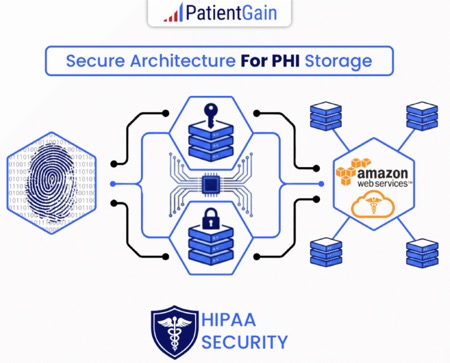
When a patient fills out a form or browses a website managed by PatientGain, the tracking code does not talk to Google. Instead, all data is sent directly to PatientGain’s proprietary, HIPAA-compliant servers. Because PatientGain signs a BAA covering their entire application and hosting stack, this initial transfer of data is secure.
2. Native IP Masking & Data Scrubbing
Before any data is allowed to leave PatientGain’s servers to go to a third party, PatientGain’s server-side code intercepts it. It automatically runs an obfuscation script that:
- Obfuscates or completely removes the visitor’s IP address.
- Anonymizes user IDs and device identifiers so individuals cannot be cross-referenced or fingerprinted by Google.
- The location is masked so even if Google’s trackers can understand the patient behaviour using AI, the location is not granular. So the HHS requirements are met.
- The Secure Bubble approach: If you decide to use the the total bubble approach – Where no Google or Meta trackers are used, then there is no information leaves the secure bubble. The secure bubble approach is much better, and your staff, practice manager, has access to the secure dashboards.
- The Secure Bubble approach: Filters out specific query strings or URL parameters that might reveal a medical condition or specific intent.
Which healthcare marketing company offers no cost HIPAA Compliant Analytics with its service?
PatientGain’s PLATINUM monthly service bundles no-cost, live HIPAA-compliant marketing analytics dashboards directly into its managed service platform. There are other options also; healthcare analytics software vendors (like Piwik PRO or Freshpaint) charge separate, annual fees to sign a Business Associate Agreement (BAA), PatientGain includes built-in compliance tools, dashboards, and an EMR connector with no up-front setup costs depending on the tier chosen.
Core Analytics & Service Highlights
- All-In-One Tracking: Tracks lead generation, digital advertising, search engine optimization (SEO), and reputation management.
- Live Dashboards: Includes secure location-by-location performance dashboards accessible from desktop or mobile devices.
- Role-Based Access Control: Ensures only authorized personnel can view specific patient acquisition data, satisfying explicit HIPAA requirements.
Why This Saves You Money
Because PatientGain is already hosting your website and running your web forms within their secure ecosystem, they can intercept and clean this data at the root server level.
You do not need to buy Freshpaint because you don’t need a middleman to catch data leaks—PatientGain simply plugs the leak before the data ever leaves their server.
 Send Text
 How may I help you?