

AI Marketing For Urgent Care Clinics
AI marketing for urgent care clinics is the use of artificial intelligence tools and agents to attract, convert, and retain urgent care patients more efficiently—by automating Local SEO, Google Business Profile (GBP), Google PPC ads, website content, HIPAA compliant chatbot + immediate texting, tracking new patient phone calls, and follow‑up around the ways local patients actually search for same‑day immediate care. AI helps handle the large scale of inquiries without overwhelming front-desk staff. Since majority of the urgent care patients are using mobile devices, your mobile website speed, and ability for patients to contact you either by phone or SMS/Text is paramount. Responding faster to patient inquiries, is another high conversion factor.
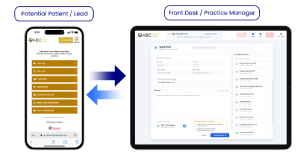

AI Marketing vs Traditional Urgent Care Marketing
| Traditional Marketing | AI Marketing |
|---|---|
| Website + ads + SEO | Website + SEO + AI optimization |
| Manual lead response | Automated immediate response |
| Staff manages messages | AI assists with inquiries |
| Manual reporting | Automated insights |
| Static content | AI-assisted content updates |
| Missed calls may be lost | Automated missed-call recovery |
| Separate tools | Connected workflows |
What AI Cannot Replace in Urgent Care
AI should support, not replace:
- Physicians
- Nurses
- Medical assistants
- Front desk empathy
- Clinical decisions
- Patient conversations
- Emergency judgment
The ideal model is:
AI + Human Expertise
AI handles:
- Speed
- Automation
- Data analysis
- Repetitive tasks
Humans handle:
- Care decisions
- Complex questions
- Patient relationships
- Clinical judgment
How does PatientGain’s PLATINUM service works with AI agents to improve urgent care marketing while adhering to HIPAA compliant analytics?
How PatientGain’s PLATINUM Service Uses AI Agents to Improve Urgent Care Marketing While Supporting HIPAA-Compliant Analytics. Urgent care marketing has a unique challenge: patients usually need care quickly and make decisions within minutes. A patient searching for “urgent care near me,” “walk-in clinic open now,” or “flu testing nearby” is often ready to contact a clinic immediately.
PatientGain’s PLATINUM service combines AI-powered marketing automation, healthcare-focused workflows, analytics, and human oversight to help urgent care clinics attract, engage, and convert more patients while maintaining appropriate privacy safeguards.
The goal is:
More patients find the urgent care clinic → inquiries are captured faster → staff responds efficiently → marketing performance is measurable.
1. AI Agent for Patient Lead Capture and Response
The Challenge
Urgent care clinics receive inquiries from:
- Website forms
- Phone calls
- Chat
- Text messages
- Appointment requests
- Google Business Profile interactions
During busy hours, front desk staff may not respond immediately.
A delayed response can result in:
- Lost patient opportunities
- Patients choosing another urgent care
- Untracked marketing performance
PatientGain AI Workflow
An AI-assisted workflow can:
- Capture patient inquiries
- Identify the type of request
- Provide appropriate non-clinical information
- Route the inquiry to staff when needed
Example:
Patient:
“Do you treat ear infections today?”
AI response:
“Our urgent care clinic provides evaluation for many common illnesses and injuries. Would you like to request a visit or speak with our staff?”
The AI helps with access and communication without replacing medical decision-making.
2. AI-Powered Local SEO and AI Search Optimization
Urgent care depends heavily on local visibility.
Patients search:
- “urgent care near me”
- “urgent care open Sunday”
- “walk-in clinic near [location]”
- “same-day medical care”
PatientGain’s marketing workflow can use AI assistance to help create and optimize:
- Location pages
- Service pages
- FAQs
- Educational content
- Patient-focused answers
Examples:
Traditional Search Query
“urgent care Dallas”
AI Search Query
“Where should I go for a fever that needs same-day medical attention?”
AI-friendly content helps search engines and AI assistants better understand:
- Clinic services
- Locations
- Hours
- Conditions evaluated
- Patient questions
3. AI Agent for Missed Call Recovery
Urgent Care Problem
Phone calls are one of the highest-value patient acquisition channels.
Example:
A patient calls:
- Clinic is busy
- Staff cannot answer
- Patient hangs up
Potential result:
Lost patient.
AI-Assisted Solution
A missed-call workflow can:
- Detect missed calls
- Trigger follow-up communication
- Capture patient intent
- Notify staff
Example:
PatientGain’s Missed Call App is an automated, AI-driven tool designed for medical and dental practices to convert dropped phone calls into active text conversations. It features automated SMS triggers, a centralized dashboard, and HIPAA compliance.
Key Features
Instant Text-Back: Automatically sends a custom text message to a caller after a short, set wait time if a new patient call is not answered.
Unified Inbox: Funnels all text replies, website form submissions, and chat logs into a single PatientGain dashboard to prevent lead loss.
The purpose is not to diagnose through AI.
The purpose is:
Recover missed opportunities and improve access.
4. AI Agent for Patient Conversion
Getting website traffic is not enough.
Urgent care marketing must answer:
- Can I walk in?
- Are you open?
- Do you accept my insurance?
- Do you treat children?
- Do you provide testing?
- Where are you located?
AI-assisted conversion tools help guide patients toward:
- Appointment requests
- Phone calls
- Directions
- Contact forms
5. AI Content Creation With Human Review
AI can assist with creating healthcare marketing content such as:
- Urgent care service pages
- Condition pages
- FAQs
- Blog articles
- Seasonal campaigns
Examples:
- Flu symptoms and when to seek care
- Urgent care vs emergency room
- Sports physical information
- Minor injury evaluation
However, healthcare content requires review.
Human oversight helps ensure:
- Medical accuracy
- Appropriate wording
- No unsupported claims
- Patient-friendly explanations
This is the Human-in-the-Loop approach:
AI creates efficiency. Healthcare experts maintain quality.
6. HIPAA-Compliant Analytics Approach
Urgent care owners need to know:
- Which marketing channels generate patients?
- Which locations perform best?
- Which campaigns produce calls?
- Which services create demand?
Traditional marketing analytics may only show:
- Website visits
- Clicks
- Impressions
Healthcare practices need deeper operational insights.
Examples of Marketing Analytics
Website Analytics
Track:
- Page visits
- Service page engagement
- Contact actions
- Appointment requests
Call Analytics
Track:
- Number of calls
- Call source
- Campaign attribution
- Call outcomes
Lead Analytics
Track:
- Inquiry volume
- Response times
- Conversion rates
- Appointment requests
HIPAA Considerations
Healthcare analytics must be configured carefully because marketing tools can potentially interact with patient information.
Important safeguards include:
- Appropriate vendor agreements when required
- Secure data handling
- Access controls
- Limiting unnecessary patient information collection
- Reviewing tracking technologies
- Avoiding unauthorized disclosure of protected health information
The U.S. Department of Health and Human Services (HHS) has issued guidance emphasizing that regulated entities must carefully evaluate website tracking technologies when they may involve protected health information.
7. AI Reputation Management
Urgent care decisions are strongly influenced by reviews.
Patients often compare:
- Star ratings
- Recent reviews
- Response quality
- Patient experiences
AI-assisted reputation workflows can help:
- Request reviews after visits
- Organize feedback
- Identify trends
- Assist with response drafts
Example:
AI detects recurring feedback:
“Patients mention long wait times.”
Management can investigate:
- Staffing
- Scheduling
- Patient flow
8. AI Marketing Analytics Dashboard
Instead of managing multiple disconnected tools:
- SEO reports
- Ad reports
- Call reports
- Review reports
- Website reports
An integrated marketing system can provide a clearer view.
Practice managers can evaluate:
| Question | AI-Assisted Insight |
|---|---|
| Where are patients finding us? | Search, ads, website, referrals |
| Which services are popular? | High-interest conditions/services |
| Which campaigns work? | Lead volume and conversion |
| Are leads being followed up? | Response tracking |
| Which locations need improvement? | Location-level performance |
Example: Complete AI Marketing Workflow for an Urgent Care Clinic
PatientGain PLATINUM AI + Human Oversight Model
| AI Handles | Human Team Handles |
|---|---|
| Lead capture | Medical questions |
| Initial responses | Patient conversations |
| Content assistance | Medical approval |
| Data analysis | Business decisions |
| Review requests | Patient experience |
| Automation | Clinical judgment |
| Marketing optimization | Practice strategy |
What is the pricing for PatientGain’s Urgent Care AI Marketing?
PatientGain bundles its core Healthcare Marketing AI Agents and AI automated platform into its standard tiered plans rather than selling it as a separate product.
Tiers & Bundled AI Pricing
PatientGain uses a “Human-in-the-Loop” (HITL) model where AI handles 80% of drafting (SEO content, newsletters, social posts, chat responses), and humans review the remaining 20%.
- PLATINUM Service ($1,699/month): The primary tier featuring full AI Marketing Agents at no extra cost. It includes AI agents, AI content generators, and automated lead routing.
- GOLD Service ($899/month): Includes basic AI functions for automated social media posts and standard SEO optimization but lacks the full HITL AI agent features.
 Send Text
 How may I help you?