

What is the difference between simple AI agent chatbot VS Full AI agent chatbot for healthcare practices?
The difference between a Simple AI Agent Chatbot and a Full AI Agent Chatbot for healthcare practices comes down to capability, automation level, integration, and business impact.
Simple AI Agent Chatbot vs Full AI Agent Chatbot for Healthcare Practices
| Feature | Simple AI Chatbot | Full AI Agent Chatbot |
|---|---|---|
| Purpose | Answer basic questions | Act like a virtual staff member – Capture leads |
| Intelligence Level | Rule-based or limited AI | Advanced AI with reasoning, and multiple follow up questions asked |
| Appointment Scheduling | Usually redirects to booking page | Can schedule appointments, ask detailed questions and then takes the information – securely saves it in a HIPAA compliant database |
| Patient Intake | No | Yes |
| Insurance Verification | No | Yes |
| Auto-Skip to Human | No | Yes – PatientGain’s data shows that patients get frustrated with too many questions from AI agents – So if the AI agent allows them to skip automation and go to a real human, it improves conversions. |
| Lead Qualification | Limited | Advanced |
| Follow-Up Automation | No | Yes |
| Multi-Channel Support | Website only | Website, SMS, Phone, Email |
| HIPAA Compliance | May be – depends on the software company who is providing the service | PatientGain provides HIPAA-compliance and includes |
| Staff Workload Reduction | Minimal | Significant – If used properly and AI agent is connected to an Auto-Respond app like SPOC app, your conversion goes up and there is less work for your staff, while increasing patient satisfaction. |
| ROI Impact | Low | High |
1. Simple AI Agent Chatbot (Basic Chatbot)
A Simple AI chatbot is designed to answer basic, frequently asked questions.
What Simple AI Chatbots Can Do
- Answer office hours
- Provide location information
- provide basic information about services
- Share contact details
- Direct users to scheduling page
- Collect basic contact info
Example
Patient asks:
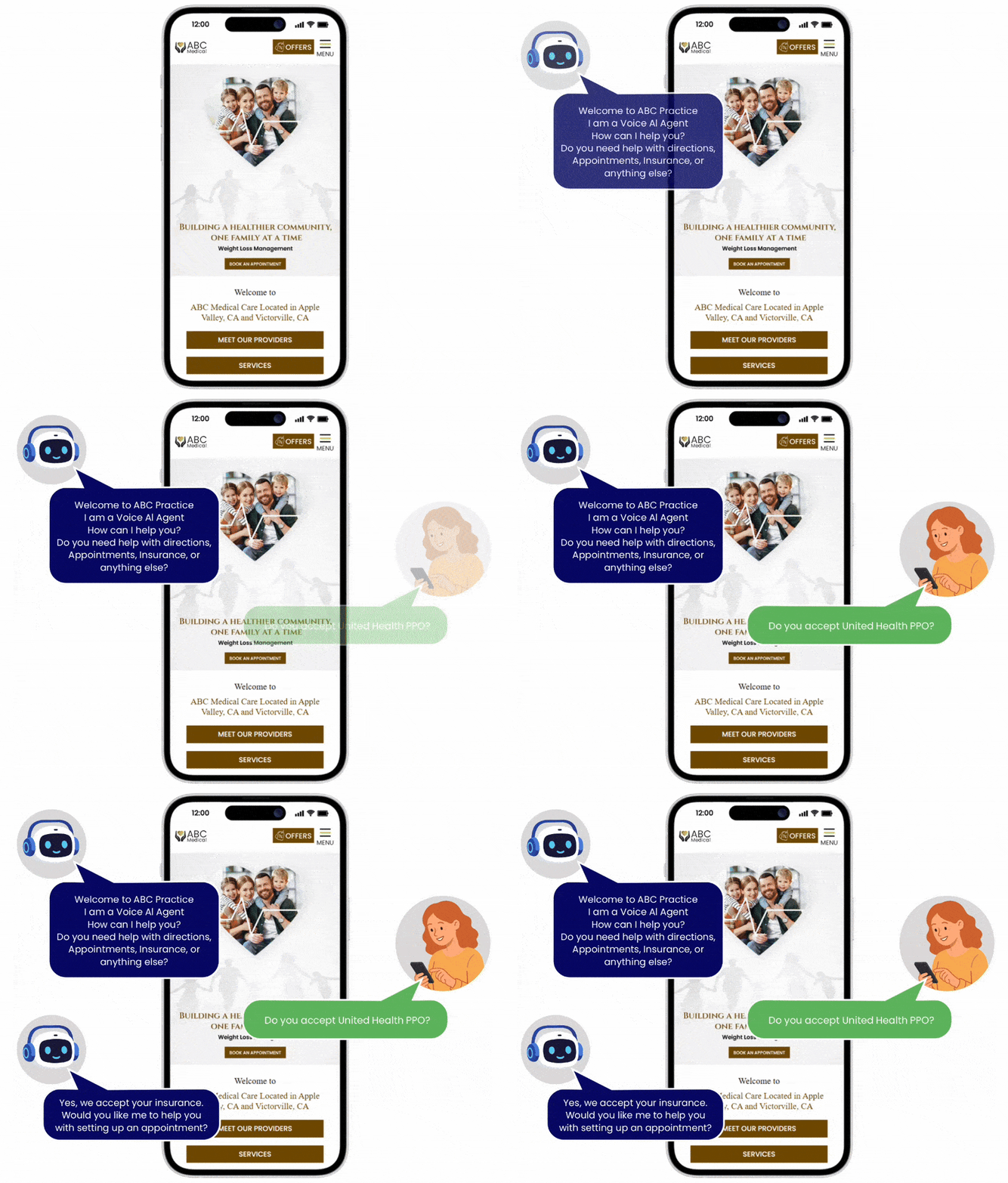
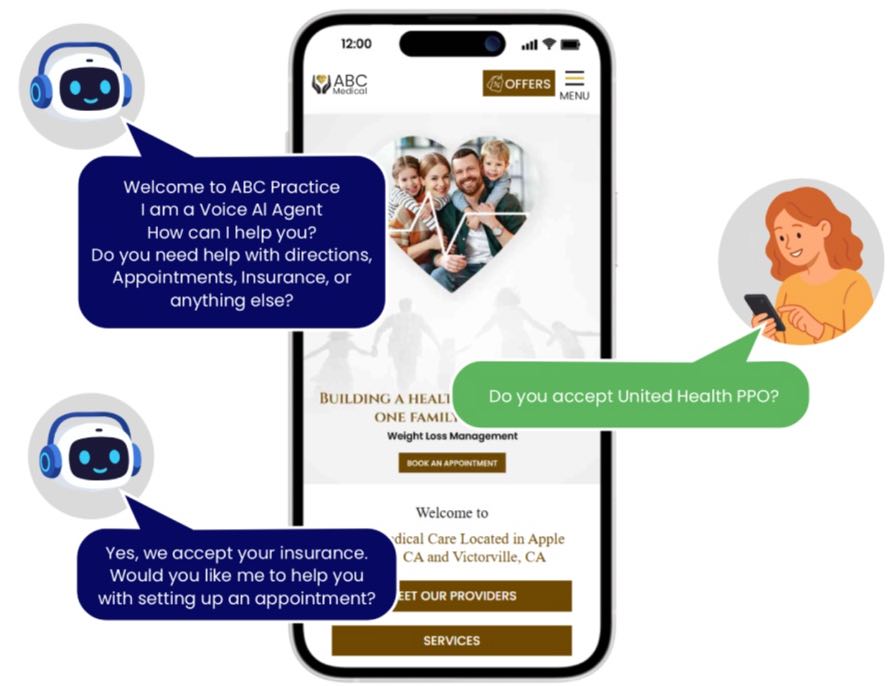
“Do you accept insurance?”
Simple chatbot replies:
“Yes, we accept most insurances, please click here to check your insurance”
That’s where the interaction usually ends.
Limitations
- Cannot schedule appointments
- Cannot check insurance
- Cannot access patient data
- Cannot follow up automatically
- Cannot qualify leads
Best For
- Small practices
- Informational websites
2. Full AI Agent Chatbot (Advanced AI Agent)
A Full AI Agent Chatbot acts like a virtual front desk staff member available 24/7.
What Full AI Agent Chatbots Can Do
Patient Communication
- Answer many questions (without medical advice)
- Provide service details (without medical advice)
- Help guide patient decisions (without medical advice)
Appointment Automation
- Schedule appointments
- Reschedule appointments
- Cancel appointments
- Send reminders
Lead Conversion
- Qualify patients
- Recommend services (without medical advice)
- Guide patients to next step (without medical advice)
Patient Intake
- Collect medical history (with HIPAA compliance)
- Collect demographics (with HIPAA compliance)
- Collect insurance information (with HIPAA compliance)
Insurance & Billing
- Verify basic insurance
- Explain payment options
- Provide rough, range based cost estimates for self-pay procedures
Follow-Up Automation
- Send reminders
- Send post-visit follow-ups
- Reactivate inactive patients
Multi-Channel Communication
- Website chat
- SMS
- Phone (voice AI)
AI + Human hybrid models are becoming the preferred solution for modern healthcare practices.
Example of Optimized AI Interaction
Patient:
“Do you offer weight loss injections?”
AI:
“Yes, we offer weight loss programs. Would you like to schedule or speak with our team?”
Options:
- Schedule Now
- Learn more about weight loss treatments
- Talk to a Team Member
- Send a quick SMS/Text to a team member
This simple approach converts better than asking 5–10 questions.
PatientGain’s data suggests that while AI agent chatbots can improve efficiency, asking too many questions can frustrate patients and lead to lower conversion rates. In healthcare, patients often prefer quick answers and the option to speak with a real human when needed. This is why a balanced AI + Human approach is becoming a modern best practice for healthcare practices.
Why Too Many AI Questions Reduce Conversions
When AI chatbots ask too many questions:
- Patients feel like they are filling out a long intake form
- Patients may not trust automated systems with sensitive health information
- Patients want immediate answers, not long conversations
- Patients often prefer human reassurance for healthcare decisions
For example:
Frustrating Experience
AI asks:
- What is your name?
- What is your phone number?
- What is your email?
- What insurance do you have?
- What symptoms are you experiencing?
- What location do you prefer?
Many patients drop off before completing this process.
The Hybrid AI + Human Strategy (Best Practice)
Modern healthcare AI systems, including those used in PatientGain’s approach, focus on:
1. Start With AI for Speed
AI handles:
- Basic questions
- Service information
- Appointment availability
- Quick answers
This gives patients instant responses.
2. Allow Easy “Talk to Human” Option
Patients can:
- Skip automation
- Request a call
- Start live chat
- Send a message to staff
This improves:
- Patient trust
- Patient satisfaction
- Conversion rates
3. Intelligent Escalation to Humans
The AI automatically routes to staff when:
- Patient asks complex questions
- Patient shows high intent (ready to book)
- Patient becomes frustrated
- Patient requests human help
This creates a smooth handoff instead of forcing automation.
Why AI + Human Improves Conversions
This hybrid approach:
- Reduces patient frustration
- Builds trust
- Increases engagement
- Improves booking rates
Healthcare is relationship-based, so giving patients access to real people improves outcomes.
Best Practice Design for Healthcare AI Agents
The most effective AI chatbots:
- Ask minimal questions
- Provide quick answers
- Offer human option immediately
- Escalate intelligently
- Work 24/7
Example of Optimized AI Interaction
Patient:
“Do you offer weight loss injections?”
AI:
“Yes, we offer weight loss programs. Would you like to schedule or speak with our team?”
Options:
- Schedule Now
- Talk to a Team Member
- Learn More
This simple approach converts better than asking 5–10 questions.
Why This Matters for Healthcare Practices
A smart AI agent should:
- Reduce staff workload
- Improve patient experience
- Increase conversions
- Avoid frustrating patients
The best-performing healthcare AI systems combine:
- Automation
- Human support
- Intelligent routing
This is why AI + Human hybrid models are becoming the preferred solution for modern healthcare practices.
AI and human hybrid models are becoming the preferred solution in healthcare by pairing AI’s data-processing speed with human clinical expertise and empathy, aiming to improve patient outcomes while reducing burnout. By 2026, these models are shifting from experimental pilots to essential, embedded infrastructure—such as ambient AI scribes and diagnostic co-pilots—that automate administrative tasks and enhance decision-making. Infinitus +3
Key Aspects of AI-Human Hybrid Models in Healthcare (2026)
- Reduced Administrative Burden: Ambient AI tools are estimated to save 1–4 hours daily per clinician by automating note-taking and charting, directly reducing burnout.
- Enhanced Diagnostics: AI acts as a “second pair of eyes” in radiology and pathology, identifying anomalies in imaging (e.g., breast cancer detection) that a human might miss, with accuracy rates for some AI-driven tools exceeding 94%.
- Proactive Patient Care: Rather than just acting in response to a visit, hybrid models use predictive analytics to identify high-risk patients (e.g., potential sepsis cases) and flag them for early human intervention.
- “Human in the Loop” Validation: Crucial to this approach is that AI does not replace clinical judgment; instead, it offers recommendations that clinicians review, edit, and sign off on, maintaining safety and accountability.
- Continuous Monitoring: Hybrid systems use data from wearables and remote monitoring to provide continuous, real-time insights, shifting care from episodic in-office visits to continuous, proactive management.
Implementation Strategies for Success
- Workflow Integration: Successful organizations embed AI directly into websites – So right from the start – Patients are empowered and and get the benefit of quick service and option to contact humans if needed. Example platforms are like SPOC from PatientGain.
- Governance and Training: With rising “shadow AI” usage, organizations are implementing strict governance, “AI safe zones,” and formal training to ensure compliance with privacy regulations. PatientGain’s SPOC app is HIPAA compliant and all audit trails are created.
- Focus on Trust: AI success depends on transparency, with tools that explain how they reached a recommendation (explainable AI) to build trust with both clinicians and patients.
AI-human hybrid models, often referred to as hybrid intelligence, have indeed become the preferred standard for modern healthcare. By 2026, approximately 86% of large health systems had adopted some form of AI, primarily focusing on models that pair machine speed with human validation. Smaller practices are in the early stages.
Core Benefits of Hybrid Models
The primary advantage is a “force multiplier” effect where AI provides scale while humans provide judgment and empathy.
- Reduced Diagnostic Error: While AI can identify patterns beyond human detection—such as spotting 24% more early-stage tumors in mammography—human oversight is critical to prevent “false positives” and overdiagnosis.
- Combating Burnout: AI “ambient scribes” and administrative tools automate routine tasks like clinical documentation and scheduling, allowing physicians to focus on face-to-face patient interaction.
- Personalized Precision: Hybrid systems integrate real-time data from wearables with genomic profiles to tailor treatments for chronic conditions like diabetes or oncology, a level of precision previously unachievable.
Key Real-World Applications
- “Digital Twins”: New hybrid models use longitudinal health data to create virtual representations of patients, simulating how they might respond to different treatments before they are administered.
- Mental Health Support: AI “therapy companions” like Clare & me and Limbic Care provide 24/7 text-based support, effectively acting as a bridge to human therapists who handle more complex clinical needs.
- Agentic AI: Moving beyond simple tools, “agentic” systems are beginning to independently plan and coordinate complex workflows, though high-stakes clinical decisions still strictly require human validation.
 Send Text
 How may I help you?