

How to Optimize a Medical Website & Dental Website for Conversational AI SEO
Examples of how a primary care medical website can optimize for conversational AI search, with a focus on structured content and specific use cases.
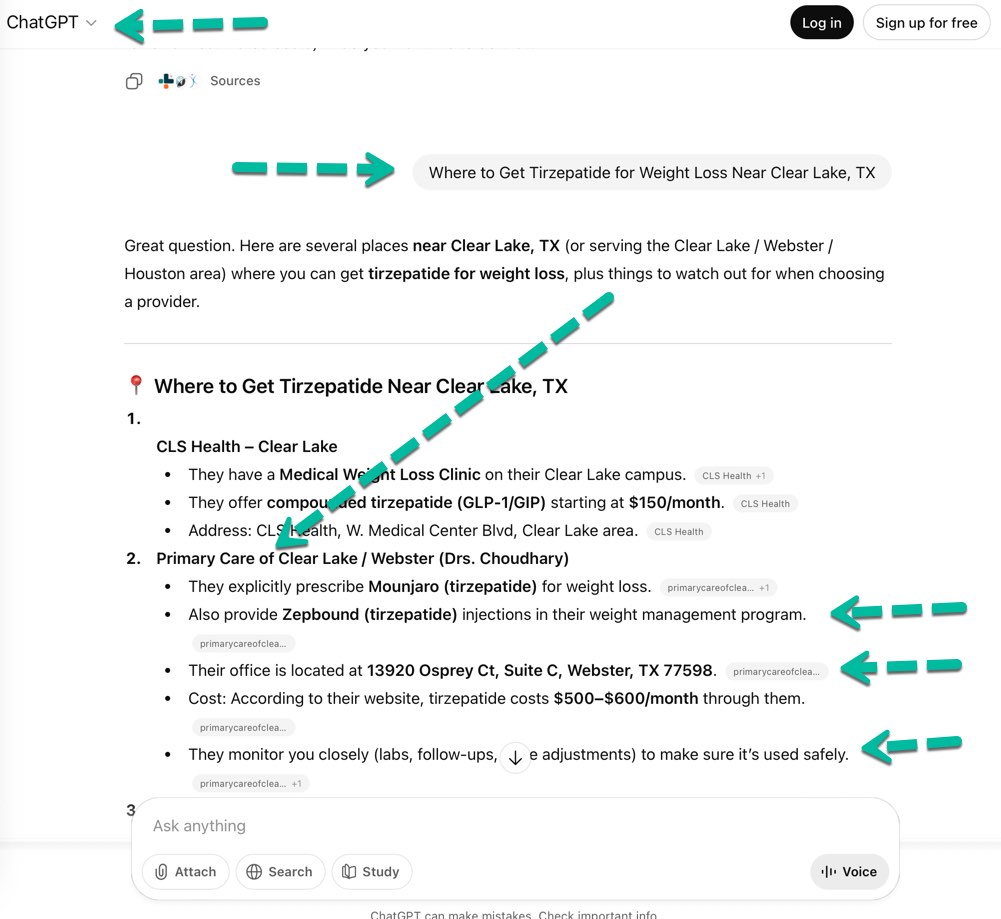
Example 1: A patient is checking with ChatGPT : “where to get tirzepatide for weight loss in clear lake tx” – See the results below. ChatGPT is recommending Primary Care of Clear lake.
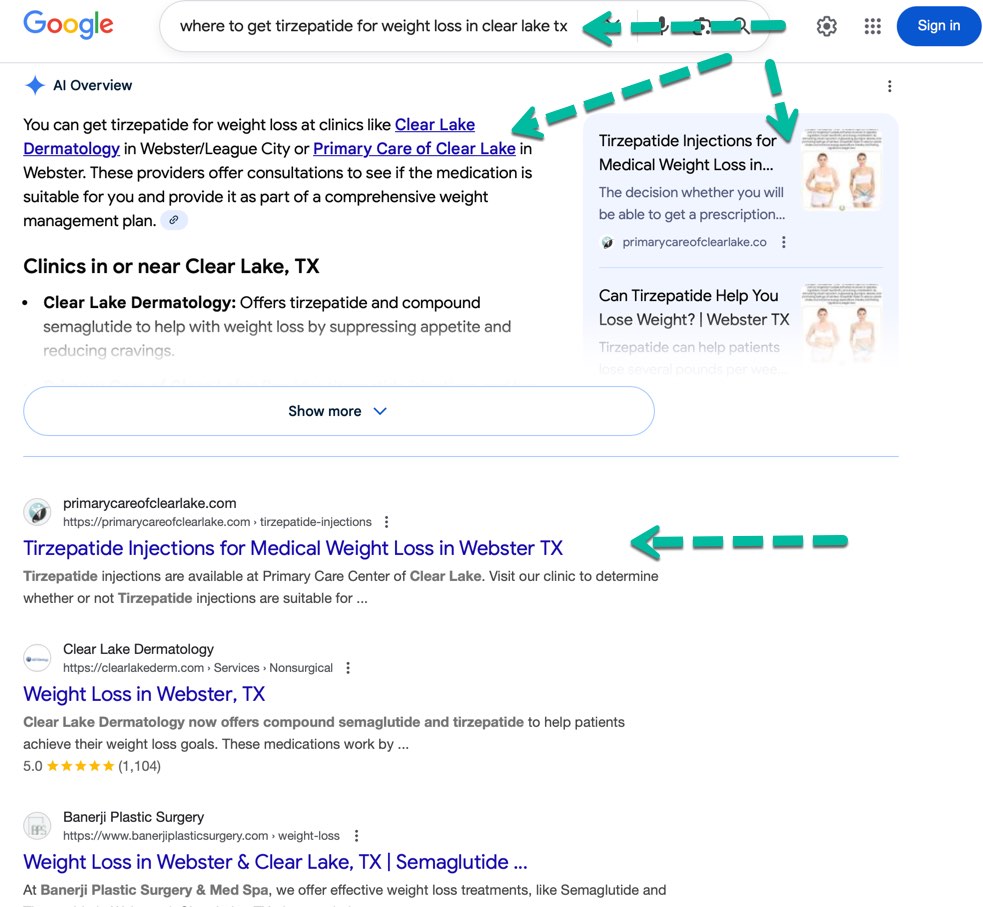
Example 2: A patient is checking with Google Gemini : “where to get tirzepatide for weight loss in clear lake tx” – See the results below. Google Gemini is recommending Primary Care of Clear lake.
Content Structure Examples
Instead of a generic page title and body, structure content around common patient questions in natural language:
- Instead of: “Diabetes Management” (page title)
- Use: “What is the best way to manage type 2 diabetes?” (H1 tag)
- Content could start with: “The best way to manage Type 2 diabetes involves a combination of medication, diet, regular exercise, and consistent monitoring of blood sugar levels.”
- Follow with bulleted/numbered lists:
- Medication: Discuss common prescriptions and the importance of adherence.
- Dietary changes: List recommended foods and meal planning tips.
- Use a link to the bio from a credentialed physician.
- Instead of: “Flu Shot Information” (page title)
- Use: “Who should get a flu shot this season, and when?” (H1 tag)
- Content could start with: “Everyone six months and older should get a flu shot annually, ideally by the end of October.”
- Add an FAQ section with specific queries:
- “Are there any side effects from the flu vaccine?”
- “Where can I get a flu shot near me today?”
- Instead of: “Urgent Care Services” (page title)
- Use: “When should I visit primary care vs. an urgent care clinic?” (H1 tag)
- Content could start with: “For minor issues like a common cold, minor cuts, or sprains, urgent care is appropriate. For chronic condition management, wellness exams, or severe symptoms, you should see your primary care provider.”
Conversational Query Examples and Targeted Responses
AI assistants pull concise answers. Your content should be designed to provide them:
| Patient’s Conversational Query | Website Content Optimization Example |
|---|---|
| “Hey Google, find a primary care doctor near me who’s open today.” | Optimize your Google Business Profile with real-time hours, accurate location details, and a link to online scheduling. |
| “What are the symptoms of strep throat?” | Create an “answer-first” blog post starting with a clear, bulleted list of common symptoms (sore throat, fever, white patches on tonsils, etc.) using MedicalCondition schema. |
| “How can I book an appointment with Dr. Smith?” | Ensure your website’s contact page and Dr. Smith’s bio page have a clear, AI-compatible call-to-action or an integrated AI chatbot for scheduling. |
| “Does my insurance cover an annual wellness exam?” | Develop a dedicated “Insurance & Billing” FAQ page that answers this explicitly and links to a list of accepted insurance plans. |
| “What should I do if I think I have a urinary tract infection?” | A blog post can guide the patient through self-assessment, provide general information, and clearly state when they should book an appointment with your clinic. |
Practical Implementation Steps
- Utilize Schema Markup: Use specific schema types (
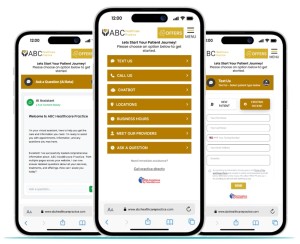
MedicalClinic,Physician,FAQPage, etc.) to provide search engines with structured data about your services, doctors, and location. - Implement an AI Chatbot: Integrate a HIPAA-compliant chatbot on your website to handle routine queries like “What are your hours?”, “Where are you located?”, or “How do I refill a prescription?”
- Incorporate “This Content Reviewed By” Badges: Add badges with physician credentials to boost E-E-A-T (Experience, Expertise, Authoritativeness, Trustworthiness) and signal credibility to AI algorithms and users.
- Ensure Mobile Performance: Since most conversational searches happen on mobile, maintain a fast-loading, mobile-friendly website.
Conclusions
Conversational medical SEO impacts patient volume by improving online visibility, increasing trust, and enhancing patient engagement, which leads to more appointments and a higher conversion rate. By optimizing for how patients actually search (e.g., asking questions), practices can appear higher in search results for relevant queries, making it easier for potential patients to find and book an appointment with them.
How conversational medical SEO increases patient volume
- Improves search visibility: By creating content that answers common health questions, practices can rank higher in search results for the terms patients use, a phenomenon known as “conversational search”.
- Builds trust and credibility: Publishing accurate, expert-level content like blog posts, FAQs, and videos establishes a practice as a trusted authority, which is crucial for patients researching health concerns.
- Enhances patient engagement: Engaging with patients through conversational chatbots or interactive content keeps them involved with the practice. This can lead to higher conversion rates, with engaged patients being more likely to book appointments.
- Drives conversions: Optimized websites that make it easy for users to find information, schedule appointments, or contact the practice convert more visitors into patients.
- Boosts local search performance: Optimizing for local terms, such as “pediatrician in Chicago” or “urgent care near me,” puts a practice in front of patients in their geographic area, driving local foot traffic and appointments.

 Send Text
 How may I help you?