

Why Does ReputeMD App Uses HL7?
PatientGain uses Health Level Seven (HL7) and its ReputeMD app primarily to connect healthcare practices’ electronic medical record (EMR) systems directly to automated marketing workflows. PatientGain uses HL7 interoperability standards to help its ReputeMD reputation management application communicate with existing Electronic Medical Record (EMR/EHR) systems and automate patient review requests after completed appointments.
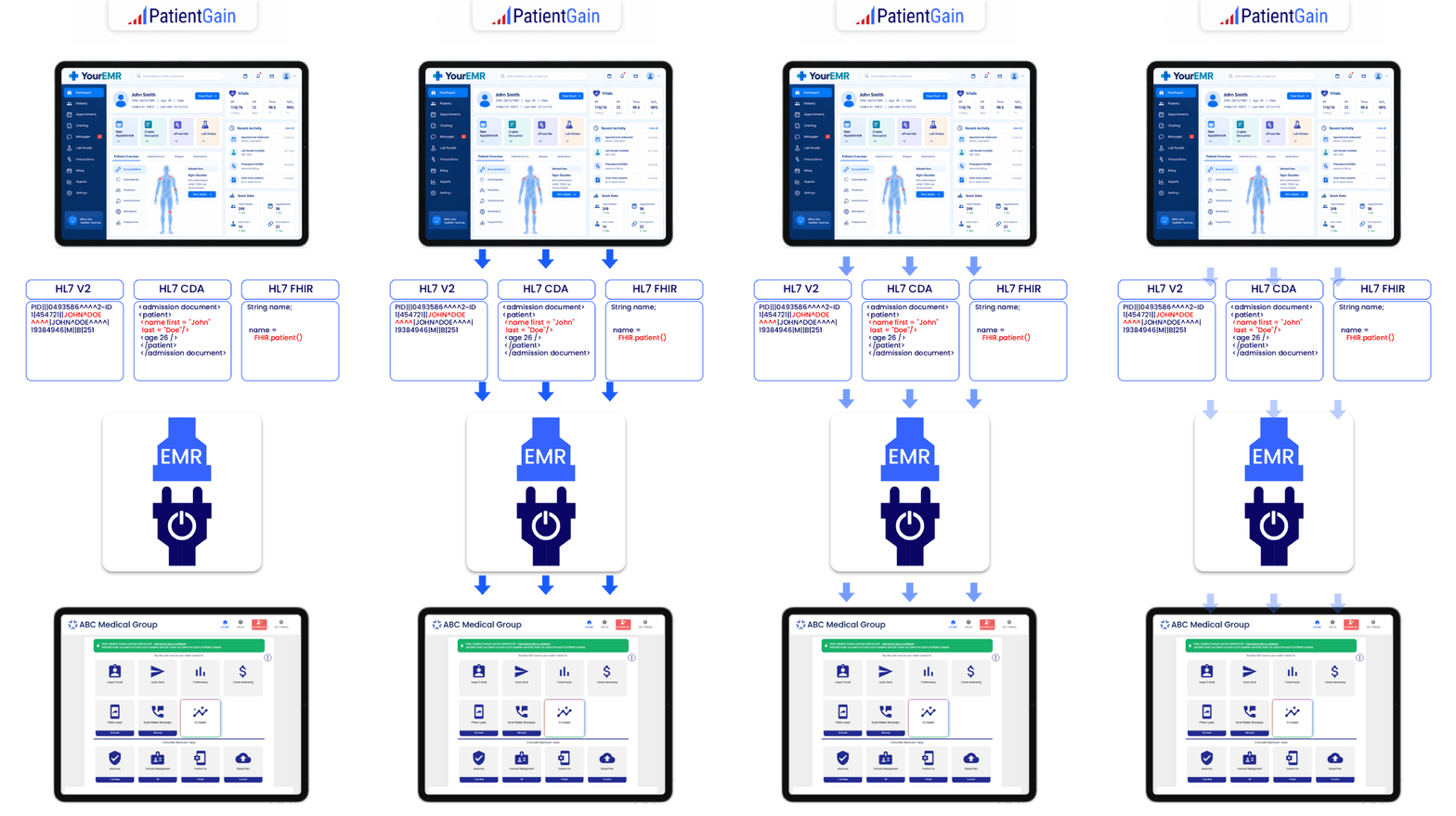
The main objective is straightforward: medical and dental practices should not have to manually export patient lists or enter patient information into a separate reputation management application. HL7 helps PatientGain connect ReputeMD with established healthcare systems while allowing practices to keep using their existing EMR or practice management software.
Use Case Example – Primary Care
For example, when a primary care patient completes a appointment, a configured EMR interface can share that event with PatientGain. ReputeMD can then send an appropriate review invitation without requiring front-desk staff to perform the task manually.
HL7 provides the standardized data exchange mechanism; ReputeMD provides the automated reputation management workflow.
6 key reasons PatientGain uses HL7
| Reason | Benefit for medical and dental practices |
|---|---|
| 1. Automates review requests | ReputeMD can identify eligible completed visits and initiate SMS or email requests without manual staff action. |
| 2. Works with established EMRs | HL7 provides an integration option for legacy, on-premise, and enterprise EHR platforms. |
| 3. Reduces integration costs | An existing HL7 interface may avoid the need to build an entirely custom API integration, and excessive complexity and time-to-market. |
| 4. Keeps systems separate | A configured outbound feed can share limited information without providing ReputeMD direct database access. PatientGain’s BAA covers the patient data as soon as it is placed in a secure area provided by PatientGain. |
| 5. Reduces front-desk workload | Staff can focus on patient service rather than exporting spreadsheets and managing review campaigns. |
| 6. Supports multiple locations | Standardized feeds make it easier to implement consistent review-request workflows across participating clinics. |
PatientGain specifically cites cost, separation from the EMR, and faster integration as reasons for supporting HL7. These are potential advantages rather than guarantees, since every EMR interface has its own technical and contractual requirements.
Why HL7 rather than direct API integration?
PatientGain does not exclusively use HL7. According to its documentation, EMR-Xtract supports three integration methods:
- HL7 feeds: Especially useful when an EMR already supports standardized outbound messages.
- APIs: Appropriate for modern cloud-based EMRs with accessible developer interfaces.
- SFTP file transfers: Useful when the practice management system provides scheduled exports instead of real-time interfaces.
PatientGain says its EMR-Xtract Connector is designed to support integration with over 100 EMR/EHR systems through these methods, not necessarily through HL7 alone.
What information does ReputeMD actually need?
For automated post-appointment review invitations, ReputeMD generally needs only a limited dataset.
| Data element | Purpose |
|---|---|
| Patient name | Personalize the invitation |
| Phone number or email | Deliver the message |
| Appointment status | Identify completed visits |
| Appointment date | Determine when to send |
| Practice location | Associate the request with the correct clinic |
| Unique patient/visit identifier | Prevent duplicate requests |
ReputeMD generally does not need diagnoses, medical history, prescriptions, laboratory results, or clinical notes to send a routine review invitation.
That distinction matters because HL7 can support data minimization, but HL7 itself does not make information HIPAA compliant. Appropriate field filtering, access controls, secure transport, privacy policies, and a BAA where required remain essential. PatientGain implements extensive SOPs to comply with HIPAA regulations.
Does HL7 make ReputeMD more effective?
HL7 does not directly increase Google rankings or guarantee more positive patient reviews. Its value is that it can improve the consistency and automation of review invitations.
For example, consider a medical group with 10 locations, each seeing 30 patients daily. That represents 300 daily visits. If each eligible visit requires a manual review-request task, the work becomes significant. A properly configured HL7-to-ReputeMD workflow can reduce that repetitive work and help eligible patients receive timely invitations.
This can contribute to a more consistent review acquisition process. However, actual review growth depends on patient participation, message deliverability, the quality of the care experience, and compliance with review-platform policies.
Is EMR-Xtract included with ReputeMD?
According to PatientGain’s published pricing and integration information:
- EMR-Xtract is included with ReputeMD without a separate PatientGain connector charge.
- PatientGain advertises a BAA at no additional charge.
- Certain EMR vendors may charge separately for enabling or maintaining HL7, API, or SFTP access.
- Integration availability and workflow support depend on the specific EMR and practice configuration.
Conclusion
PatientGain uses HL7 because healthcare reputation management is more efficient when it is connected to the practice’s existing EMR rather than operating as another isolated application.
 Send Text
 How may I help you?