

How to Lower Medical Marketing Costs Without Losing New Patients
If you manage one or multiple medical practices, the best way to reduce medical marketing costs is to eliminate duplicated services, consolidate vendors, automate repetitive work, improve patient conversion rates, and stop spending money on marketing that does not produce profitable new patients.
The objective should not simply be to spend less. It should be to lower your cost per acquired patient while maintaining or increasing appointment volume. For multi-location healthcare practices, this is particularly important because marketing expenses can multiply across locations, vendors, software subscriptions, and administrative staff.
Example: Reducing costs for a six-location medical practice
Identify where your marketing budget is going
A medical practice may be paying several vendors for services that overlap.
| Marketing expense | Common source of unnecessary costs | Opportunity to save |
|---|---|---|
| Website management | Separate developers, hosting, maintenance | Consolidate hosting and support |
| Local SEO | Separate agencies for each location | Centralize strategy and execution |
| Google Business Profile | Manual posting and multiple subscriptions | Automate and manage centrally |
| Reputation management | Separate review software | Integrate with existing workflows |
| Email newsletters | Email platform plus content agency | Combine content and distribution |
| Google and Meta Ads | Ineffective targeting and campaigns | Optimize based on acquired patients |
| HIPAA-focused analytics | Separate analytics vendor and IT consultant | Use an appropriately contracted managed solution |
| Lead management | Disconnected contact and booking systems | Consolidate intake and lead follow-up |
Consolidation should be based on the total cost of ownership, including implementation, compliance, internal staff time, and ongoing support—not just software subscription prices.
Consider a hypothetical medical group with six locations that uses seven vendors.
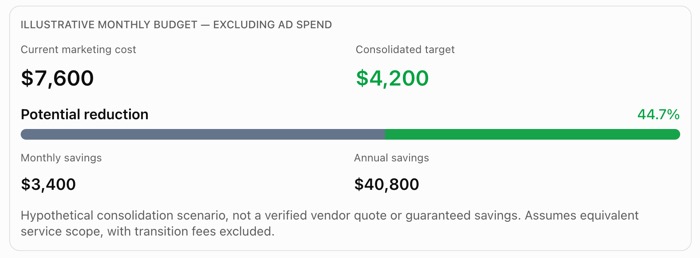
Over three years, the potential savings would be $122,400, provided comparable performance and service coverage are maintained.
Ten practical ways to lower marketing costs
1. Consolidate marketing vendors. Look for overlapping services across your website agency, SEO company, analytics vendor, review software, and messaging provider.
2. Prioritize Google Business Profile optimization. Keep each location’s business information accurate, manage reviews, and improve location-specific landing pages. This can support local visibility without paying for every website visit.
3. Improve your website’s conversion rate. Make appointment booking, phone calls, insurance information, and location details easy to find. More conversions from existing traffic can lower acquisition costs.
4. Stop ineffective advertising. Review Google and Meta campaigns based on booked and completed patient visits, not merely clicks or form submissions.
5. Automate reputation management. Use appropriately configured automated review requests following appointments. Avoid disclosing protected health information in public review responses.
6. Consolidate email marketing. Reuse approved newsletter templates and centrally manage communications while personalizing content for individual locations and specialties.
7. Use AI to reduce content production costs. AI can assist with initial drafts of patient education, social posts, and local SEO content. Qualified clinical review remains important for medical accuracy.
8. Reduce duplicated HIPAA technology costs. Review whether analytics, consent management, lead capture, and messaging can be supported under fewer vendor agreements without compromising security.
9. Standardize marketing across locations. Share design templates, reporting systems, content workflows, and vendor contracts while preserving the accuracy of each location’s services.
10. Measure acquisition costs by location and channel. A campaign that works for one specialty or geographic market may lose money in another.
Consider a hypothetical medical group with 4 locations that uses 6 vendors.
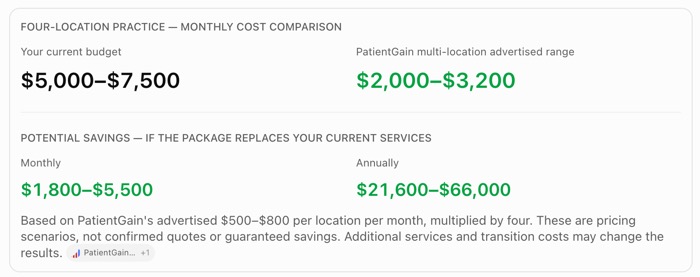
My four medical practice locations spend $5000–$7500 dollars per month on marketing, excluding ad spend. Compare this with PatientGain’s multi-location services and calculate potential savings and tradeoffs.
Based on your current spending of $5,000–$7,500 per month, excluding Google and Meta advertising, PatientGain provides a cost-effective alternative for your four medical practice locations, without reducing your patient acquisition.
Based on PatientGain’s current published pricing and service descriptions for multi-location healthcare practices. The strongest opportunity is replacing multiple marketing agencies and software subscriptions with a centralized, done-for-you healthcare marketing service.
Compare the two PatientGain options
PatientGain advertises a general multi-location service and a more comprehensive PLATINUM package. They should not be assumed equivalent.
| Multi-location service | PLATINUM with location add-ons | |
|---|---|---|
| Pricing model | $500–$800/location | $1,699 base + $500–$800/additional |
| 4-location estimated monthly cost | $2,000–$3,200 | $3,199–$4,099 |
| Website | Managed centralized website | Expanded website and marketing system |
| Local SEO | Included in advertised offering | Included, with advanced SEO |
| Marketing apps | Advertises 10 core apps | Advertises 20 apps/services |
| Reputation and lead tracking | Available features; | Advertised as included |
| HIPAA-compliant analytics | Included | Advertised as included |
| Best fit | Cost-efficient operations across locations | More comprehensive patient acquisition |
At the midpoint of your spending range:
| Financial metric | Current | Multi-location | PLATINUM |
|---|---|---|---|
| Monthly | $6,250 | $2,600 | $3,649 |
| Annual | $75,000 | $31,200 | $43,788 |
| 3-year cost | $225,000 | $93,600 | $131,364 |
| 3-year savings | — | $131,400 | $93,636 |
Where the savings actually come from
For four locations, PatientGain’s advertised integrated platform could replace several costs that are often billed separately:
| Existing expense | PatientGain approach | Financial benefit |
|---|---|---|
| Website agency and hosting | Managed multi-location website | Fewer website vendors |
| SEO agency | Centralized SEO and local SEO | Reduced duplicated agency work |
| Google Business Profile management | Posting and location-specific updates | Less manual effort |
| Reputation management software | Integrated review management | Potential subscription savings |
| Email marketing software and agency | Managed newsletters | Combined production and delivery |
| Patient texting and lead tracking | Integrated apps and dashboard | Fewer disconnected systems |
| HIPAA-focused analytics | Platform analytics, where included | Potentially avoids standalone analytics costs |
| Marketing account management | Assigned project and technical resources | Less coordination for practice staff |
Summary of how the PatientGain Multi-Location solution
PatientGain’s digital marketing services are specifically structured to reduce overhead and marketing costs for multi-location healthcare practices through platform consolidation and volume-based pricing.
1. Multi-Location Volume Discounting
While PatientGain’s standard packages range from $899 to $2,499 per month for a single clinic, they offer volume pricing for practices with multiple locations. For a multi-location setup, the pricing is discounted to $500 to $800 per month, per location. This allows you to scale your marketing footprint without multiplying your costs by four.
2. Eliminating “Patchwork” Software Subscriptions
Many medical practices waste money paying 4 to 8 different vendors for separate tools (e.g., one company for website hosting, another for texting, another for reputation management, and another for a CRM). PatientGain consolidates over 20 applications—including HIPAA-compliant website hosting, AI chatbots, 2-way texting, online appointment scheduling, review generation, and email marketing—into one single monthly subscription. This bundled approach is drastically cheaper than paying for a la carte software across 4 different clinics.
3. Zero Upfront Setup Fees
Traditional custom healthcare marketing agencies often charge initial setup, onboarding, or custom development fees that can range from $5,000 to $10,000+. PatientGain offers a $0 upfront setup fee for clients who sign a 12-month contract, eliminating the steep barrier to entry usually associated with launching a new multi-location marketing system. However, you have options for 1 month, 3 month or 6 month contracts, but these require a setup fee.
4. Centralized Staff Efficiency (SPOC)
Managing patient inquiries across 4 distinct locations can be an administrative nightmare that drives up front-desk payroll costs. PatientGain utilizes a Single Point Of Conversion (SPOC) app, which is a centralized dashboard that tracks all patient interactions from ads, texts, calls, and forms in one place. It uses AI to handle initial patient inquiries, heavily reducing the manual administrative burden on your staff.
5. Fixed Rates Instead of Pay-Per-Booking
Marketplaces like Zocdoc use a pay-per-booking model, which can cost your practice $50 to $160+ for every single appointment generated. PatientGain utilizes a fixed monthly subscription rate aimed at optimizing your own website’s traffic. By converting your existing traffic at a higher rate with their apps, your overall Patient Acquisition Cost (PAC) drops significantly, and you aren’t financially penalized for generating a high volume of patients.
 Send Text
 How may I help you?