

What is Healthcare Reputation Review Velocity Spikes?
A review velocity spike is a sudden, sharp increase in the rate at which a business or product listing receives customer reviews. Platforms like Amazon and Google use automated spam filters that view these abrupt clusters of feedback as a major red flag trigger for review manipulation, often resulting in account suspensions, review deletions, or listing penalties.
Because coordinated fake-review networks generate feedback in rapid bursts, the algorithm’s baseline logic assumes that a sudden surge in review frequency is artificial.
Why Review Velocity Spikes Trigger Warnings
Algorithms prioritize a steady, continuous progression of reviews over sporadic influxes. When review acquisition sharply deviates from a business’s historical average, it trips safety filters.
| Risk Level | Review Pattern | Algorithmic Status |
|---|---|---|
| Low Risk | Steady organic growth that scales naturally with sales volume. | Approved: Signals an active, trustworthy business. |
| Moderate Risk | Post-launch surge supported by documented advertising campaigns. | Monitored: Usually cleared if transactional data matches traffic. |
| High Risk | Sudden, undocumented spike in a short window after months of silence. | Flagged: Triggers automated spam filters and manual audits. |
| Critical Risk | Rapid spike accompanied by identical phrasing or same-IP reviewers. | Enforced: Leads to immediate review deletion or account suspension. |
Common Triggers (Legitimate vs. Illegitimate)
The primary danger of review velocity spikes is that legitimate business success can look identical to fraud to an automated algorithm. Common events that trigger these spikes include:
- Viral Social Media Moments: An unexpected influencer mention or viral video can send a heavy burst of traffic, driving months worth of sales and reviews into a few days.
- Aggressive Launch Campaigns: Businesses using massive email newsletter blasts, street teams, or beta-tester networks to coordinate a single “review day”.
- Marketing Promotions: Large one-time giveaways or steep promotional discounts drive a high volume of transactions, which naturally convert into a wave of reviews 2 to 4 weeks later.
- Black-Hat Manipulation: Buying fake 5-star reviews or utilizing review pools that drop dozens of ratings simultaneously.
Healthcare Reputation Management is Different
In healthcare reputation management, a review velocity spike functions as a primary trigger for automated anti-fraud and anti-spam protocols. Because medical practices handle highly sensitive, highly regulated consumer services (“Your Money or Your Life” or YMYL categories), search engines and platforms monitor their listing behaviors under extreme scrutiny. A sudden influx of patient feedback—even if 100% authentic—flags the practice profile as a high-risk entity.
The Technical Triggers: Why Healthcare Is Flagged Fast
Platforms analyze review velocity using historical baseline ratios. If a medical clinic typically receives 3 to 5 reviews a month and suddenly receives 25 reviews in 48 hours, automated systems assume the practice has purchased fake reviews or deployed a “black-hat” bot net.
In healthcare, this trigger is compounded by specific operational risks:
| The Action Taken | Why the Algorithm Flags It | The Platform Enforcement Result |
|---|---|---|
| Historical EHR Database Blasts | Sending an SMS/email blast to thousands of past patients simultaneously results in a sudden mass upload of reviews. | Review Purging: Massive blocks of real, heartfelt patient reviews vanish within days. |
| Front-Desk Tablet/Kiosk Sign-ins | Handing an iPad or tablet to patients at check-out or providing an office guest Wi-Fi network. | IP Block & Policy Violations: Google Business Profile (GBP) strictly bans requesting reviews on-premise. Multiple reviews from the same IP address or device trigger instant removal. |
| Provider-Specific Push Campaigns | Launching an internal contest pushing patients to mention their specific doctor or nurse’s name. | Filtered Text: Google’s upgraded AI filters explicitly ban pressuring patients to mention specific staff names, filtering the review text out as unnatural or coerced. |
Real-Time Consequences for Healthcare Practices
Under Google’s upgraded merchant protection systems, the consequences of triggering the velocity filter are severe:
- Profile Pausing & Warning Banners: If Google detects a severe review velocity spike, its systems will temporarily freeze all new reviews on your practice’s profile. It will also display a public notification banner warning prospective patients that contributions have been paused due to unverified activity.
- Local 3-Pack Rank Drop: Local SEO factors heavily value consistency over volume. A clinic that gets 5 reviews a month consistently will outrank a clinic that gets 40 reviews in one week and then zero for the rest of the year.
- Review “Ghosting” (Pending States): Reviews will look active to the patient who wrote it on their own device, but will be completely hidden from the public profile because the system quarantined the wave of submissions for manual audit.
How Healthcare Managers Prevent Spikes
To successfully manage a clinic’s reputation without tripping these triggers, healthcare marketers use the following strategies:
- Implement a “Drip” Automation: When connecting reputation software to an Electronic Health Record (EHR) system (like Epic, eClinicalWorks, or Athenahealth), request queues should be batched. Instead of texting the entire monthly patient file on Friday afternoon, queue the software to text patients precisely 2 to 24 hours after check-out.
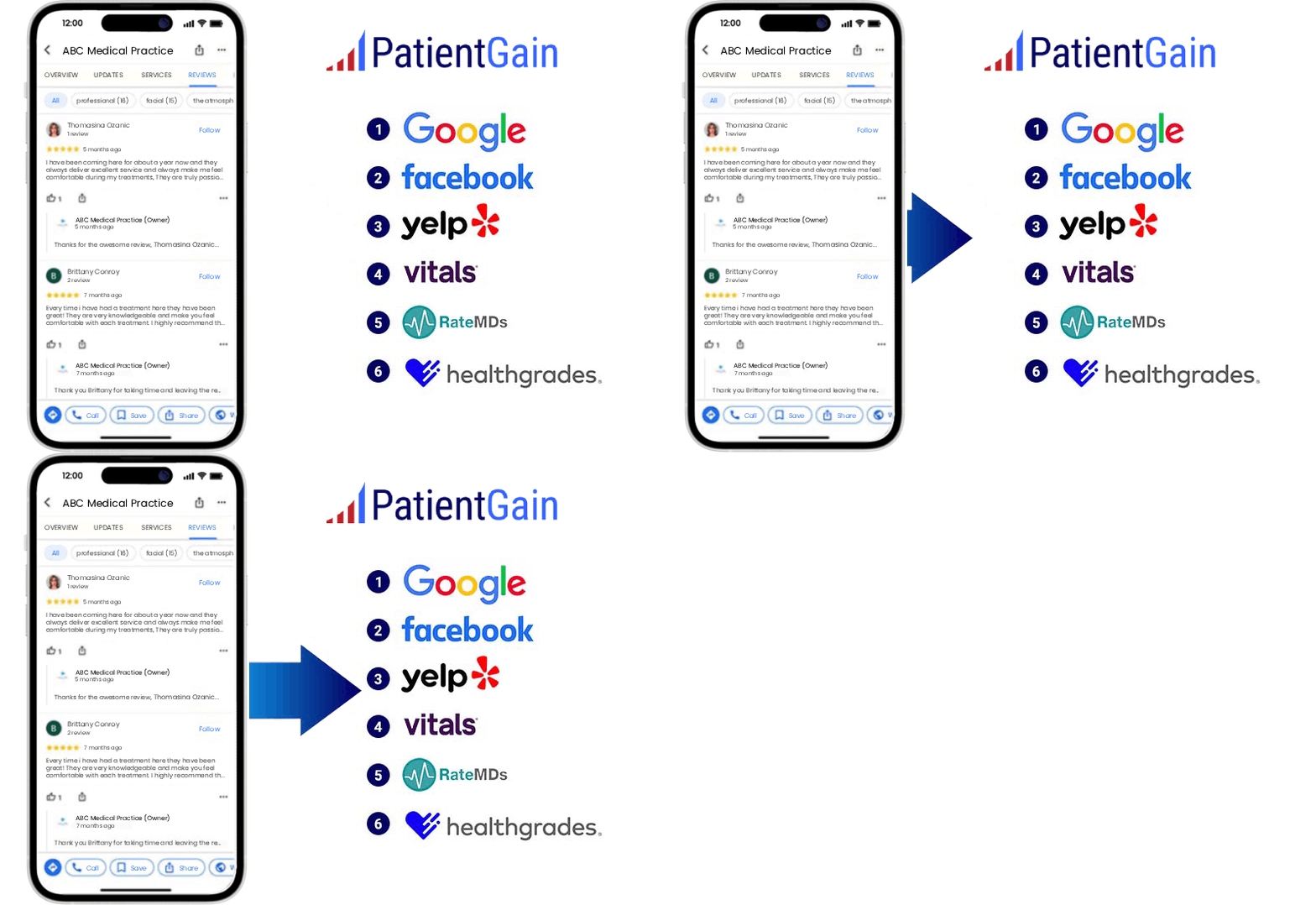
- Diversify the Target Footprint: Do not funnel 100% of review requests to Google Business Profile. Set up routing rules that distribute the traffic to healthcare-specific platforms like Healthgrades, WebMD, or insurance portals.
- Enforce Off-Premise Requests: Train front-desk receptionists to stop handing devices to patients. Instead, verbal cues should remind patients to look out for an automated text or email they can comfortably open on their own cellular data networks once they get home.
What is PatientGain’s Strategy?
Implement a policy-compliant review request process using suitable email, SMS, InLobby tablet app, or QR codes. Invite patients to share genuine experiences without incentives or selectively requesting positive reviews. However, heavy automation must be handled carefully to avoid triggering search engine spam filters. for example if your healthcare practice typically receives 8 reviews per month, and all of sudden you get 30 new reviews, GBP , Yelp and other review websites are very likely flag them.
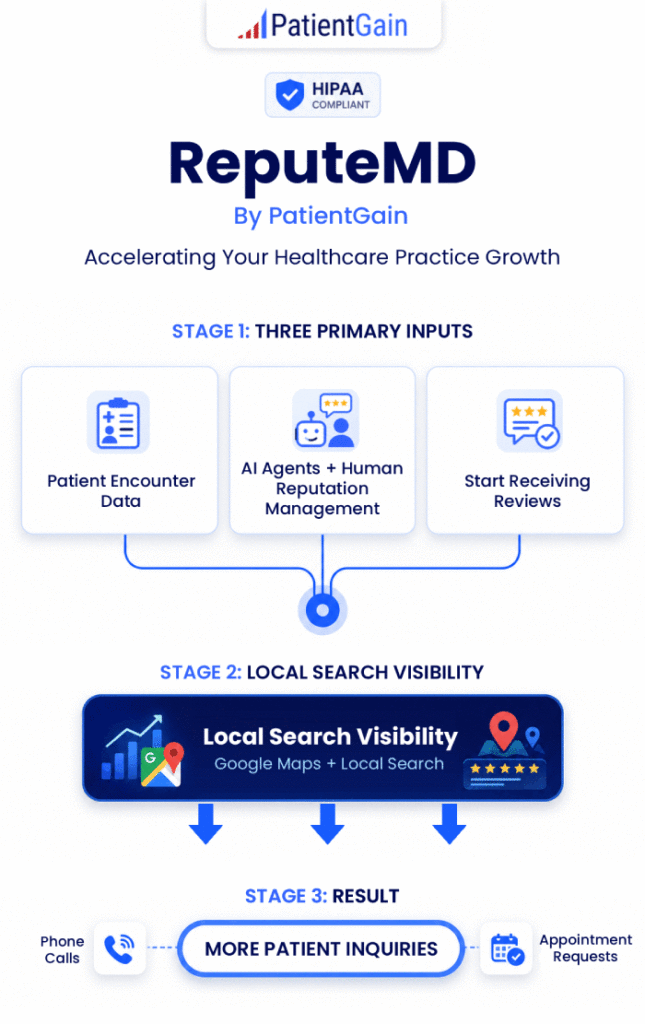
Medical marketing automation platform PatientGain, highlights the mechanical dangers of aggressive review generation. While using policy-compliant tools (like SMS, email, or QR codes) is encouraged, sudden automation-driven spikes will trip anti-spam filters.
1. “Implement a policy-compliant review request process… without incentives or selectively requesting positive reviews.”
- Accuracy Status: 100% Accurate.
- The Reality: Major platforms strictly prohibit “review gating” (the practice of pre-screening patients to only ask happy ones for a review) and offering incentives (like a gift card or free service). For healthcare, selectively requesting reviews violates Google’s Maps User-Generated Content Policy and can result in legal penalties from regulatory bodies like the FTC.
2. “Heavy automation must be handled carefully to avoid triggering search engine spam filters.”
- Accuracy Status: 100% Accurate.
- The Reality: When a medical practice signs up for a new automation service, they often make the mistake of doing a “historical blast”—sending a text or email review request to thousands of past patients all at once. Even though the patients are real and their feedback is genuine, the sudden resulting flood of submissions triggers automated protection mechanisms. Platforms assume a bot or a paid review farm has been hired, causing the system to automatically filter or delete the feedback.
3. “If your healthcare practice typically receives 8 reviews per month, and all of a sudden you get 30… GBP, Yelp, and other websites are very likely to flag them.”
- Accuracy Status: Highly Accurate (The Core Danger).
- The Reality: Google Business Profile (GBP) and Yelp look at historical review velocity baseline ratios. A jump from 8 to 30 reviews in a month is nearly a 400% increase.
- While Google won’t necessarily suspend a medical practice GBP for a single spike, its algorithms are highly sensitive to sudden deviations. If a baseline breaks too rapidly, Google will frequently place the reviews into a hidden “pending” status, filter them out entirely, or place temporary restrictions on the profile.
Safe Implementation Strategies
To scale up review numbers safely using automation, practices should adhere to a structured protocol:
| Strategy | Action | Why it Works |
|---|---|---|
| Drip Campaigns | Batch automated SMS/email requests over weeks rather than blasting a full database in one day. | Mimics normal, steady organic patient flow. |
| Point-of-Care Triggers | Automate requests to trigger automatically 1 to 2 hours after a patient checks out. | Spreads out reviews naturally based on daily appointment volume. |
| Multi-Platform Routing | Direct patients to different platforms (e.g., Google, WebMD, Healthgrades, Yelp). | Distributes review velocity safely across multiple authority sites. |
 Send Text
 How may I help you?