

Marketing Solutions For Multi Location Healthcare Organizations
Marketing solutions for multi-location healthcare organizations refer to centralized digital strategies, software platforms, and operational frameworks designed to promote multiple MSOs, hospitals, clinics, or specialty practices under a single unified brand while maintaining distinct, localized relevance for each community or each location.
Core Objectives
- Maintain Brand Consistency: Ensure uniform messaging, visual identity, and compliance standards across all regional facilities.
- Drive Local Patient Acquisition: Tailor SEO and advertising so individual branches rank high for local searches like “urgent care near me”.
- Scale Operations: Manage reviews, local listings, and campaign rollouts from a single centralized dashboard rather than ad-hoc local efforts.
What is PatientGain’s Marketing Solution for For Multi Location Healthcare Organizations?
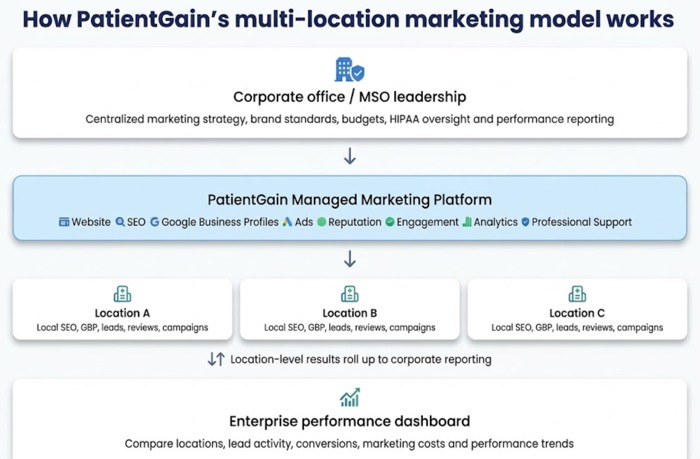
PatientGain offers a centralized, Done-For-You (DFY) healthcare marketing and patient acquisition solution designed for medical groups, dental groups, MSOs, DSOs, urgent care networks, specialty practices, and healthcare organizations operating multiple locations. Instead of treating each medical office as a separate marketing business, PatientGain combines centralized strategy, localized marketing execution, healthcare-focused applications, analytics, and professional support into one managed system.
Example leads dashboard for the corporate staff – So they can see the marketing performance of each location 24×7, in real-time secure dashboards.
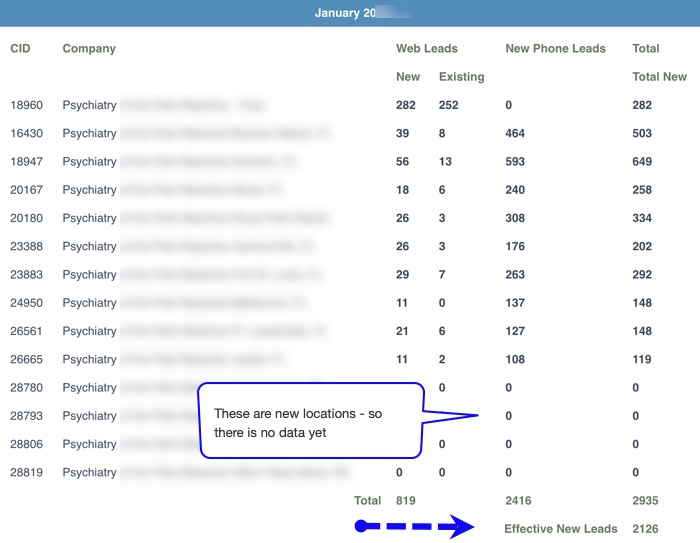
Notes about the data:
Overall Tracking: The report monitors lead generation across multiple clinic locations, breaking down the data into Web Leads (New and Existing) and New Phone Leads.
Total Volume: Across the tracked locations, the system recorded a total of 819 New Web Leads and 2,416 New Phone Leads. This resulted in a raw total of 2,935 new leads.
Effective Leads: A specific callout at the bottom of the report calculates the “Effective New Leads” for the month at 2,126.
Performance Distribution: Lead types vary heavily by location; for instance, some established clinics rely heavily on phone leads (e.g., generating 593 and 464 new phone leads), while another location generated 282 new web leads but zero phone leads.
New Locations: A note on the dashboard indicates that the bottom four clinics listed have zeroes across all columns because they are “new locations” and do not have data yet.
Its core value proposition is:
One marketing platform. One coordinated strategy. One provider relationship. Individual marketing performance for every location. to PatientGain’s multi-location solution is intended to consolidate 5–8 separate marketing and technology providers, reduce administrative overhead, and make marketing performance easier to manage across locations.
Rather than forcing healthcare organizations to manage multiple logins and apps across different branches, PatientGain replaces five to eight disjointed service vendors (such as standalone CRMs, text-messaging apps, review software, and web hosts) with a single centralized infrastructure, with a single BAA for HIPAA Compliance.
The specific architecture and pillars of PatientGain’s Multi-Location Healthcare Marketing Solution include:
1. Centralized Strategy with Localized Execution
- Single Domain, Multi-Location Setup: PatientGain uses a “Single Hub Domain Strategy”. Instead of building separate custom domains for each clinic, they build a single unified parent site featuring fast, semi-custom location pages.
- Effective Target Area (ETA) Optimization: Campaigns are localized to dominate the unique geographic radius where each individual clinic draws 80% of its patients. This includes location-specific, proximity-based SEO and geo-targeted paid ads (Google, Facebook, Instagram) without agency markups on keywords.
2. The Unified Software Stack (Replacing “Vendor Sprawl”)
By integrating everything under a single platform, corporate marketing managers and local office staff share the same dashboard ecosystem:
- SPOC (Single Point of Conversion) Dashboard: A central hub that aggregates real-time marketing data, conversion rates, and KPI performance metrics across every individual facility and the corporation as a whole.
- HIPAA-Compliant Analytics & CRM: Tracks patient inquiry channels, calls, text messages, and appointment requests securely, shielding Protected Health Information (PHI) under a single master Business Associate Agreement (BAA).
- Reputation Manager: Automatically requests, tracks, and manages 5-star patient reviews on site-specific directory listings (Google Business Profile, Yelp, Healthgrades) to maximize local trust.
- QuickSend & Patient Engagement: A built-in two-way SMS texting app and AI medical chatbot to help local front desks coordinate paperwork, insurance, and appointments quickly.
3. “Human-in-the-Loop” AI & Service
PatientGain heavily utilizes AI-driven marketing automation and AI agents to handle routine content generation, social media management, and data tracking. However, to bypass strict healthcare industry regulatory barriers (YMYL—Your Money or Your Life guidelines), they utilize a Human-in-the-Loop (HITL)framework. Every account is assigned a dedicated human project manager and technical resource to review compliance, handle brand management, and provide account oversight.
4. Transparent, Volume-Based Pricing
Unlike traditional medical marketing agencies that rely on billable labor or high setup costs, PatientGain operates on a predictable subscription-based software model. Their localized multi-site marketing tier typically scales from $500 to $800 per month, per location, with volume-based discounts tailored for larger clinic groups, Urgent Care networks, and Management Services Organizations (MSOs).
5. Comprehensive Single BAA
Instead of requiring healthcare systems to manage and sign 5 to 8 separate BAAs for different point solutions (e.g., one for web hosting, one for the CRM, one for two-way texting, and one for reputation software), PatientGain consolidates the compliance liability under one master contract.
What is Covered Under the Single BAA?
PatientGain’s single BAA functions as a blanket safeguard for all aspects of their platform:
- All 20+ Digital Applications: The agreement spans their built-in medical CRM, online scheduling engines, 2-way patient SMS, and secure review-gathering tools.
- The Software and Data: All electronic Protected Health Information (ePHI) captured, processed, or stored within the system—including patient names, phone numbers, email addresses, and server-side tracking data—is covered.
- The “Human-in-the-Loop” Service: Uniquely, the BAA covers not just the software stack, but also PatientGain’s managed account services, meaning their human project managers and support staff operate legally within your compliance barrier.
Backend Infrastructure Security
While PatientGain signs the master BAA with your healthcare organization, their underlying technical architecture is reinforced by upstream cloud agreements:
- AWS & Google Cloud Infrastructure: PatientGain’s platform is deployed on Amazon Web Services (AWS) and Google Cloud Platform (GCP) secure health servers, both backed by their own respective enterprise BAAs to ensure military-grade data encryption at rest and in transit.
By providing this singular, comprehensive agreement on day one, PatientGain shifts technical data privacy responsibilities away from your internal staff and removes the administrative burden of auditing multiple service providers, vendors and marketing vendors.
For a CFO or practice owner, the deciding question should be: Can PatientGain demonstrate that its integrated solution reduces our total cost per acquired patient while maintaining service quality, reliable measurement and appropriate HIPAA safeguards?
Assume you have a 21 location practice network. Your healthcare practices have grown over the last 18+ years. during this expansion you have also acquired 3 locations. You have 3 fulltime internal IT staff and marketing staff. You have also worked with 4 marketing companies over the last 18+ years.
PatientGain’s multi-location marketing service works as an “all-in-one” HIPAA-compliant platform that centralizes a practice’s brand strategy while automating localized execution for each clinic location. It is designed to replace 5 to 8 fragmented software apps and traditional agency services with a single software-driven system.
Traditional Agency vs. PatientGain
| Feature | Traditional Agency Model | PatientGain Platform |
|---|---|---|
| Pricing Basis | Labor-intensive, hourly consulting fees | Flat SaaS pricing ($500–$800/mo per location) |
| Tech Stack | Fragmented across 5–8 individual apps | Completely unified under one platform |
| Data Visibility | Fragmented, delayed manual monthly reports | Real-time, centralized live dashboards |
| HIPAA Compliance | High risk – as applications have different BAAs and agency may have its own BAA | One master BAA that covers the apps, data and service |
| Ad Spend | Often includes hidden markups or variable fees | Transparent billing directly to ad networks |
There are 3 full time internal staff in IT and Marketing + marketing agency and 8 different vendors, and on average each clinic’s marketing cost is $1743 per month + advertising costs for Google PPC – how does this compare with PatientGain’s $800/mon/location service ?
PatientGain multi-location pricing of $500–$800 per location per month and describes a centralized website, local SEO, healthcare marketing applications and managed support.
1. Your current operating model
| Operating factor | Current arrangement |
|---|---|
| Medical practice locations | 21 |
| Internal IT and marketing employees | 3 full-time |
| External marketing vendors | 8 |
| Average external marketing cost per location | $1,743/month |
| Total external marketing cost | $36,603/month |
| Google PPC advertising | Additional, amount unspecified |
| Vendor coordination | Internal team |
| Total external marketing spend annually | $439,236 |
This organization has two layers of marketing expense: the eight external technology vendors and the three internal employees. The internal employees’ fully loaded compensation is necessary to calculate your complete TCO.
2. Three-year cost comparison — external marketing services
Assuming spending remains constant, with no inflation or annual fee increases:
| Financial metric | Current model | PatientGain at $800 |
|---|---|---|
| Monthly cost per location | $1,743 | $800 |
| Total monthly cost | $36,603 | $16,800 |
| Year 1 | $439,236 | $201,600 |
| Year 2 | $439,236 | $201,600 |
| Year 3 | $439,236 | $201,600 |
| 3-year total | $1,317,708 | $604,800 |
| 3-year difference | $712,908 saved |
 Send Text
 How may I help you?