

Healthcare Online Reputation Management As An Operational Intelligence Tool
From the perspective of a Practice Manager or a Practice Owner: How can I use my clinic’s online reputation management (ORM) service like ReputeMD as an operational intelligence tool?
As a practice manager or practice owner, your primary responsibility is not simply to attract more patients. You must ensure that your practice operates efficiently, patients receive a positive experience, staff perform effectively, and the business continues to grow. Most practices use online reputation management software to increase Google reviews and improve star ratings.
But what if you could use those same patient reviews to discover why patients are unhappy, identify operational inefficiencies, and improve how your practice operates?
That is where online reputation management becomes an Operational Intelligence Tool. Instead of asking, “How many five-star reviews did we get this month?” you can ask:
- Are my patients waiting too long to see their doctor?
- Are my front-desk employees creating a positive experience?
- Which of my clinic locations are performing poorly?
- Are billing mistakes damaging patient satisfaction?
- What are patients saying about our providers?
- Are operational problems costing us repeat visits or referrals?
A HIPAA compliant service like ReputeMD can provide a starting point for answering these questions through patient feedback and online review monitoring. ReputeMD sends automated review requests, EMR integrations, centralized review monitoring, and multi-location dashboards. Advanced operational analytics should be evaluated separately.
1. Turn patient complaints into actionable business intelligence
For example, imagine you are the owner of a primary care practice receiving the following Google reviews:
The doctor was excellent, but I waited 50 minutes after my scheduled appointment.
Patient scheduling and wait-time investigation
I called three times to schedule an appointment, but nobody answered.
Phone responsiveness and front-desk staffing review
The staff was friendly, but I received a bill I didn’t understand.
Billing accuracy and financial communication audit
The physician explained everything and the check-in process was very smooth.
Identify practices worth replicating across the teamIllustrative patient comments and suggested management responses.
These are not merely positive or negative reviews. Each provides a potential clue about how your clinic is operating.
The objective is to identify recurring themes, verify the underlying facts, and resolve the root causes.
2. Ten ways I can use patient reviews to improve my clinic
| Area | Intelligence I can gather | What I can do |
|---|---|---|
| 1. Front desk | Complaints about staff interactions | Improve training and check-in procedures |
| 2. Appointment scheduling | Patients cannot find appointments | Adjust scheduling rules and capacity |
| 3. Wait times | Repeated reports of long waits | Compare scheduling with actual visit times |
| 4. Phone management | Patients cannot reach the office | Audit missed calls and staffing patterns |
| 5. Billing | Unexpected bills and payment confusion | Review billing accuracy and explanations |
| 6. Provider communication | Patients feel rushed or uninformed | Provide communication coaching and support |
| 7. Follow-up process | Complaints about delayed callbacks or referrals | Improve follow-up accountability |
| 8. Patient retention | Patients say they may not return | Identify and resolve recurring dissatisfaction |
| 9. Location performance | One location receives more complaints | Compare workflows across clinics |
| 10. Staff recognition | Repeated praise for employees | Recognize excellent service and share best practices |
Importantly, review comments describe patient perceptions. They should trigger investigation rather than automatically being treated as proof of employee misconduct, clinical errors, or poor care.
How does ReputeMD service works?
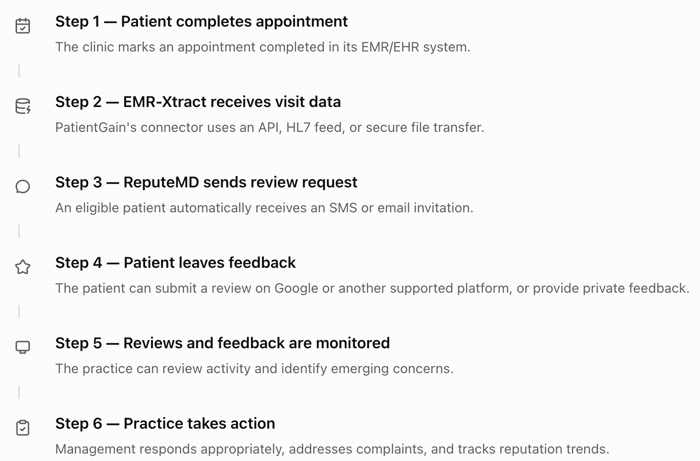
ReputeMD, developed by PatientGain, is an automated, HIPAA-compliant online reputation management platform that generates patient reviews and intercepts negative feedback for healthcare practices. It operates by integrating directly with a clinic’s existing workflow to solicit feedback without requiring manual effort from the front-desk staff. ReputeMD is a Done-For-You (DFY) online reputation management service designed specifically for medical practices, dental offices, urgent care clinics, and multi-location healthcare organizations.
Its main purpose is to help healthcare practices automatically request authentic patient reviews, monitor their online reputation, collect patient feedback, and reduce the amount of manual work required from their staff. ReputeMD combines software automation, EMR/EHR connectivity, AI-assisted workflows, and human oversight.
How ReputeMD works — from patient checkout to reputation management
2. What makes ReputeMD different from a basic review-request app?
| Capability | How it benefits the practice |
|---|---|
| EMR/EHR integration | Reduces manual entry and creates automatic post-visit triggers |
| SMS and email requests | Makes it convenient for patients to leave reviews |
| Google and other review platforms | Helps build an ongoing presence where prospective patients research providers |
| Private patient feedback | Gives managers another channel for identifying problems |
| Multi-location dashboards | Helps regional managers compare review performance |
| Provider-specific review workflows | Supports the online reputation of individual physicians |
| Video testimonials | Offers an additional format for approved patient testimonials |
| Human-assisted service | Reduces work for internal marketing and administrative employees |
| HIPAA-focused workflows and BAA | Provides contractual and technical safeguards for handling patient data |
PatientGain ReputeMD as a managed service rather than simply a software license. It is based in HITL and a project-manager is assigned to your account, for workflow maintenance, and assistance with reputation-related activities.
Example: How a practice manager would use ReputeMD
Suppose your clinic sees 40 patients daily.
Without automation, staff must remember to request reviews, manually send links, and check review platforms.
With ReputeMD, a properly configured EMR connection can automatically identify eligible completed visits and initiate review invitations.
For a practice operating 22 days per month, this represents approximately 880 appointments from which eligible review requests could potentially be generated. It does not mean every visit qualifies or that 880 reviews will be received.
Your staff can instead concentrate on patient check-in, appointments, calls, and care coordination.
Meanwhile, the practice manager can review reputation activity to identify complaints involving wait times, scheduling, billing, and staff communication.
How ReputeMD supports multi-location practices
For a medical group with several locations, PatientGain advertises corporate-level reporting, individual location dashboards, and restricted management access. This can help management distinguish between individual locations rather than treating the entire organization’s rating as one number.
For example, a regional manager could compare review volume and average ratings for five clinics, investigate a sudden decline at one location, and share successful patient-service practices from another. The real opportunity is to use feedback as operational intelligence, not just as a marketing metric.
How much does ReputeMD cost?
| Practice size | Advertised monthly price |
|---|---|
| 1–2 providers | $100/provider, $200 minimum |
| 4 providers | $300 |
| 10 providers | $600 |
| 3+ locations | $500 per location, with package limits |
EMR-Xtract connector and a BAA are included, although an EMR vendor may charge additional integration fees. ReputeMD is also advertised as included with PatientGain’s PLATINUM service.
Summary
ReputeMD’s value is combining automated post-appointment review requests, healthcare-specific integration, and managed reputation services into one workflow. For many clinics, this means less administrative work and more consistent review collection. For a multi-location practice, it can additionally support provider-level visibility, location comparisons, and identification of recurring patient-experience concerns.
 Send Text
 How may I help you?