

Does Healthcare Reputation Management Helps With Healthcare Local SEO?
Yes, reputation management directly and significantly impacts local SEO for doctors and medical practices. Search engines like Google use reputation signals as a core metric to determine which healthcare providers to recommend in local search results (such as the Google Map Pack). Google explicitly confirms that having more reviews and positive ratings can improve a business’s local ranking. Check pricing for ReputeMD monthly full service and done for you service.
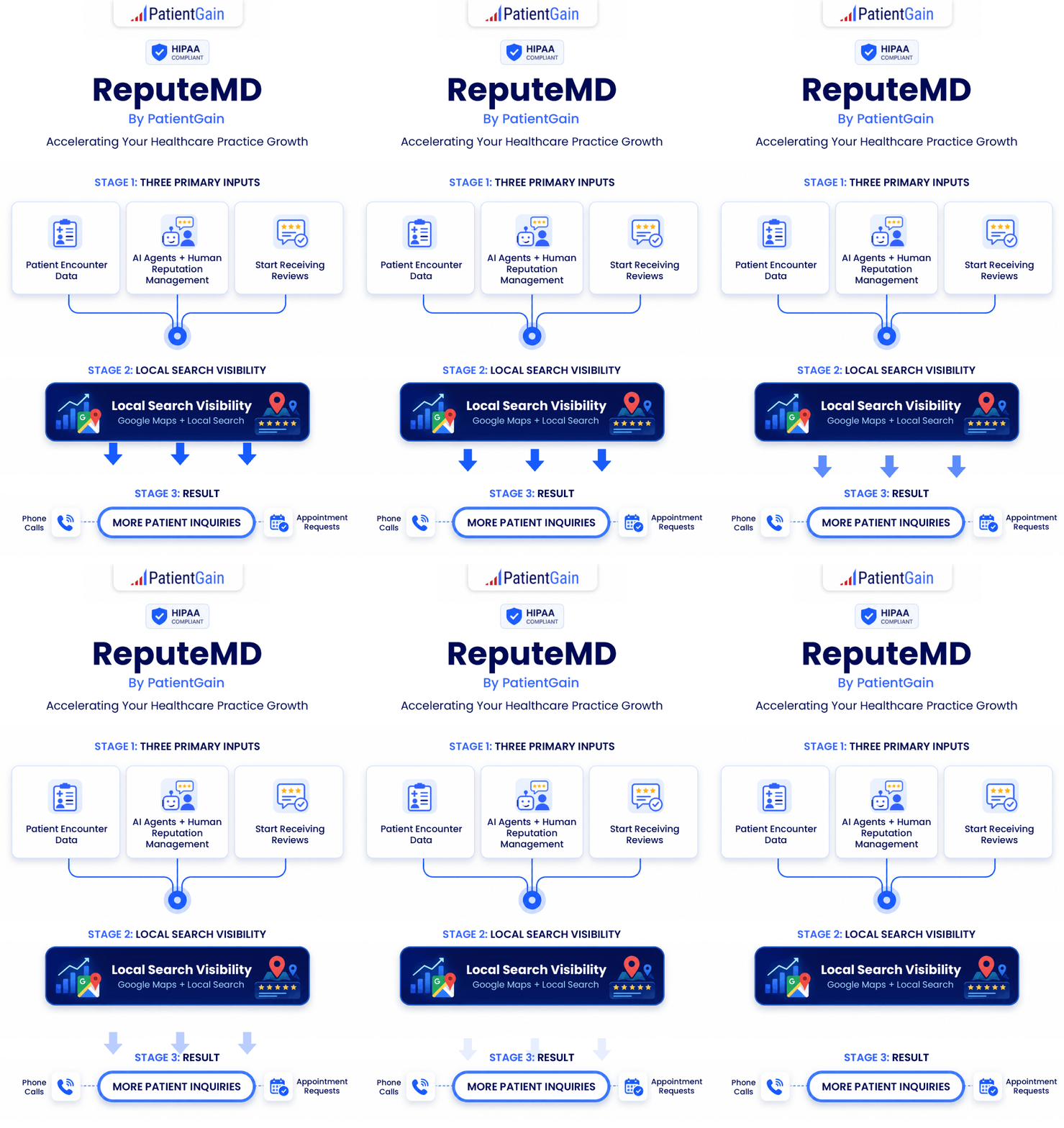
Google Business Profile Help
However, reputation management is not just about collecting five-star reviews. An effective strategy involves obtaining authentic patient feedback, maintaining a strong Google Business Profile (GBP), professionally responding to reviews, and improving the patient experience.
1. How reputation management impacts Google’s local rankings
Google identifies three primary factors that influence local search visibility:
Relevance
How closely your medical practice matches what a patient is searching for, such as “dermatologist near me” or “urgent care in Dallas.”
Distance
How close your practice is to the patient or the geographic area referenced in the search.
Prominence
How well-known and established your practice is. Google specifically identifies review volume and positive ratings as contributing factors. Reputation management primarily supports the third factor, prominence, and helps patients choose your practice once they find it.
2. Five ways reputation management helps Local SEO
| Reputation management activity | Local SEO and business benefit |
|---|---|
| 1. More authentic Google reviews | Supports Google’s prominence signals and builds social proof |
| 2. Higher average star ratings | Positive ratings can contribute to local ranking and patient confidence |
| 3. Consistent new reviews | Shows prospective patients recent experiences; a direct review-recency ranking effect is not officially confirmed |
| 4. Professional responses to reviews | Demonstrates responsiveness and credibility, although Google does not confirm response frequency as a direct ranking factor |
| 5. Feedback about healthcare services | Helps prospective patients understand the practice and provides insights for improving service quality; keywords in reviews are not a guaranteed ranking boost |
3 key pillars of successful local SEO for doctors and reputation management
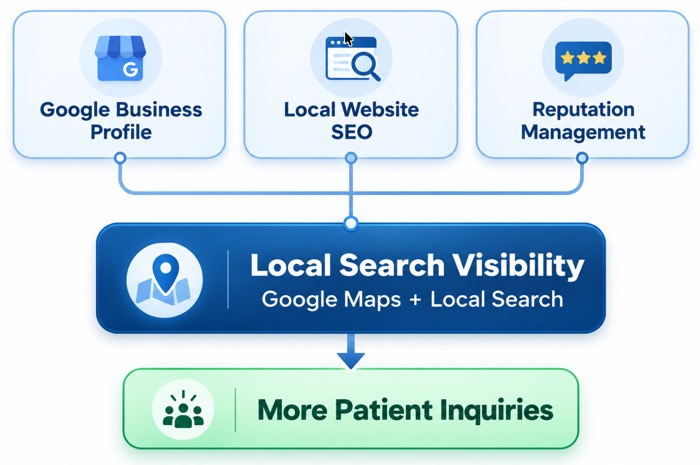
1. The Three Primary Inputs
- Google Business Profile (GBP): Serves as your practice’s primary digital storefront. It controls how your practice appears in Google Maps, local search packs, and direct entity searches. Key elements include primary/secondary category setup, NAP (Name, Address, Phone) consistency, operating hours, photos, and direct booking links.
- Local Website SEO: Provides search engines with context regarding your clinical expertise and geographical reach. It involves optimizing location-specific landing pages, conditions treated, local schema markup (e.g.,
MedicalBusinessorPhysician), site speed, and mobile responsiveness. - Reputation Management: Acts as both a ranking engine and a conversion engine. It focuses on acquiring a consistent flow of fresh, authentic patient reviews, responding to feedback, and maintaining high star ratings across platforms like Google, Healthgrades, and Vitals.
2. Convergence into Local Search Visibility
When all three inputs are optimized, they feed into Local Search Visibility (Google Maps + Local Search):
- Google Maps (The Local 3-Pack): Google’s algorithm evaluates Relevance (from your Website SEO and GBP categories), Distance (proximity to the searcher), and Prominence (driven largely by your Reputation Management star count, review volume, and velocity).
- Organic Search Results: Strong local website structure paired with high GBP engagement signals helps your practice dominate both map placements and standard organic links below the map.
3. Conversion to More Patient Inquiries
High visibility alone is not enough; the synergy between these elements is what converts searchers into actual patients:
- Trust Triangulation: A prospective patient finds your practice via local search (Website/GBP visibility), evaluates your credibility via your rating and review feedback (Reputation Management), and feels confident enough to take action.
- Frictionless Action: Integrated GBP features (such as call buttons, map directions, and online scheduling links) allow high-intent users to convert into phone calls or online appointment requests immediately.
How does PatientGain’s ReputeMD app helps?
PatientGain’s ReputeMD service is a specialized online reputation management application designed specifically for the healthcare sector. It acts as the operational tool that executes the reputation management strategies required to boost local SEO and patient conversion.
1. Automates the Review Acquisition Loop
To boost local SEO, a practice needs a continuous, fresh stream of reviews. ReputeMD removes the manual work from this process:
- Automated Outreach: The app automatically sends personalized text messages or emails to patients after their visits, containing a direct link to leave a review.
- Automated Follow-ups: If a patient doesn’t leave a review initially, the system sends spaced-out reminders to increase the capture rate.
- In-Clinic Capture (iPad Kiosk): The app is designed to work on iPads, allowing front desk staff to capture reviews from happy patients while they are still in the lobby or checking out.
2. Feeds Local Search and AI Algorithms
The app is specifically engineered to generate the five core data signals that AI recommendation engines and Google’s Local Search algorithms use to rank healthcare practices:
- Average Rating: Filters out low-quality providers.
- Recency of Reviews: Signals to Google that the practice is currently active and delivering good care.
- Number of Reviews: Builds statistical confidence and market authority.
- Sentiment Analysis: Uses natural language processing to identify keywords in the reviews (e.g., “gentle pediatrician”).
- Volume and Quality of Feedback: Measures the velocity at which new reviews come in and the descriptive depth of the patient’s text.
3. Strict HIPAA Compliance
A major hurdle for medical local SEO is generating patient-driven content without violating privacy laws.
- Secure Handling: Unlike generic business review tools (like those used for restaurants), ReputeMD features end-to-end data encryption.
- Digital Authorization: It utilizes secure digital signatures and granular authorization tracking, replacing non-compliant generic “photo releases”.
- Frictionless Experience: Patients do not have to download any third-party apps to participate, ensuring a higher completion rate while remaining secure.
4. Integration with Google Business Profile (GBP)
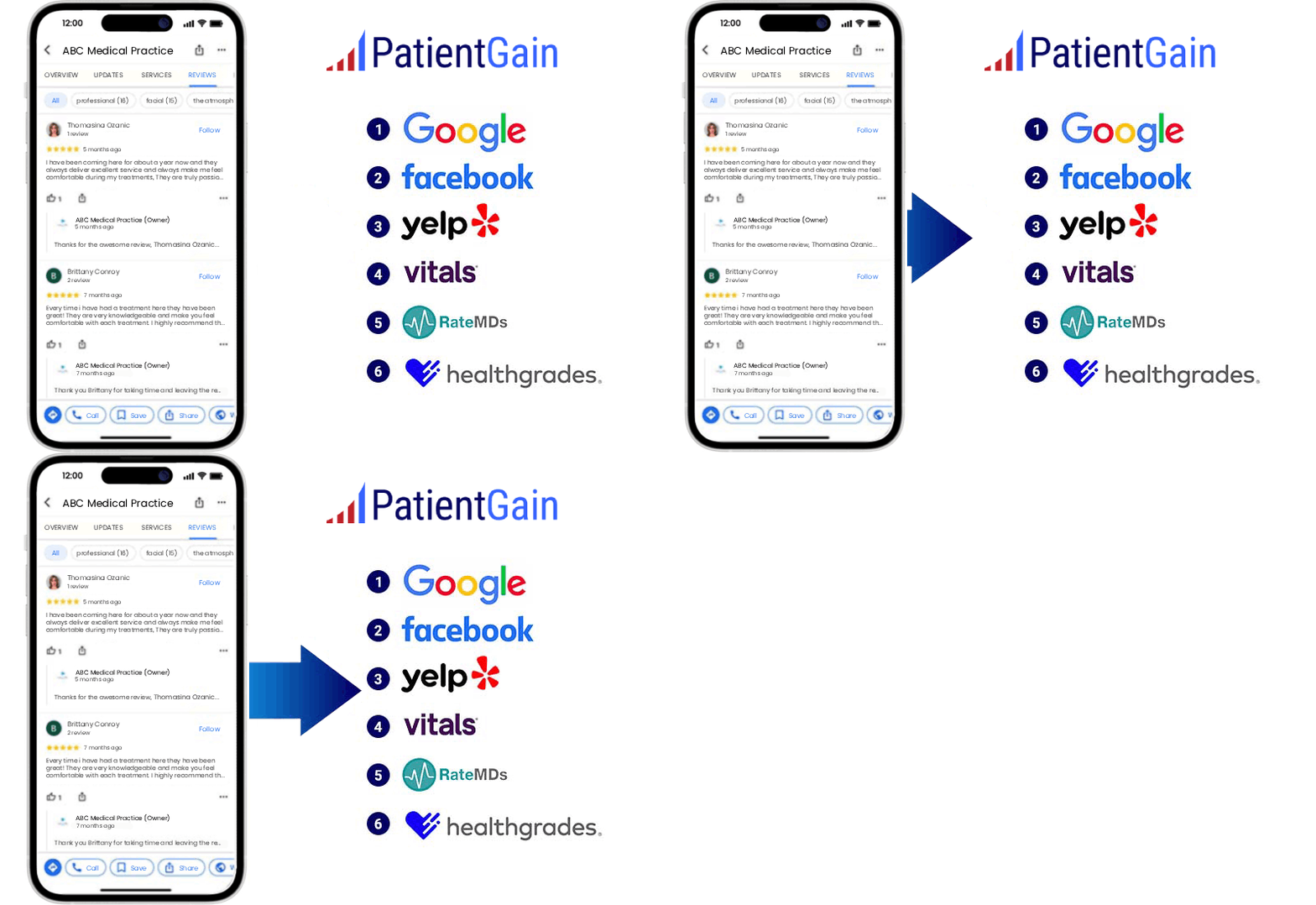
Because over 80% of online reputation success for medical practices comes from Google Reviews, ReputeMD focuses heavily on channeling patient feedback directly to your Google Business Profile. By allowing patients to post reviews in their own words on GBP, the app directly influences the primary metric Google uses to rank the Local Map Pack.
 Send Text
 How may I help you?